I hadn’t been in Peru for over a couple decades. My earlier sojourn took me to the Amazon in pursuit of a shaman’s offering of sorely needed enlightenment. That episode, initially written for The Miami Herald, is detailed here. Amazon Off-Line: Eat This Shrub and Call Me in the Morning
Long overdue for a return, last fall I was offered a chance to attend Peru’s first eco-travel conference, with side explorations of northeast and northern Peru, including the world’s highest tropical mountain range and ancient ruins far older than Machu Picchu. Those locales proved an embarrassment of riches, well-worth recounting. But I’ll do that down the road. For now I’ll describe my return to the lower elevation of Lima. I had to kill a day awaiting a midnight flight to the States. At the baggage claim, I overheard a couple fellow travelers setting up passage on a boat to islands off the coast of Lima. They aimed to swim with the sea lions that ruled those seas. That sounded terrific. I quickly signed on.
First though, a mild panic. Stepping outside Jorge Chávez International Airport, I entered a giant snow globe filled with dirty snow. I looked about for a fire spewing ashes. None was seen. I closed one eye. Nothing. Switched. Uh oh. Only one eye could see the drifting ashes. Nothing to be done then.
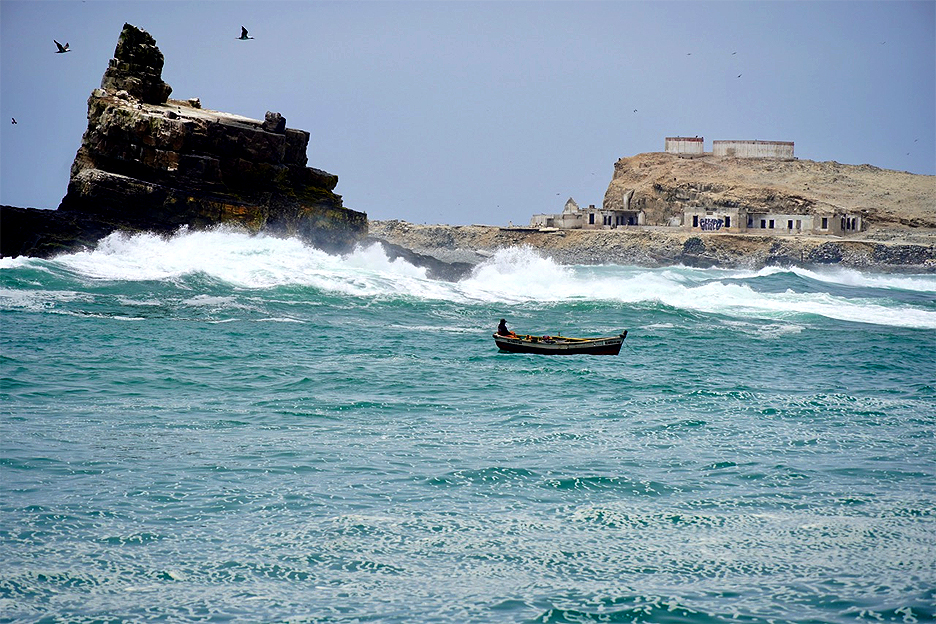
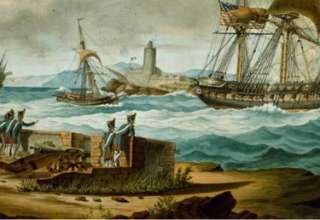
We proceeded to find the taxis that waited to take us on a fifteen minute ride northwest to the port of Callao. No time to explore the port environs founded by Spain in 1537. Others also founded it, over the prior 10,000 years, focused on fishing its waters. English and Dutch pirates were fond of attacking the settlement, stimulating the construction of high defensive walls. Pirates were nothing compared to the earthquakes and tsunamis that in the mid-1700’s wiped out most of the population. The sea’s ample fishing continued to attract those willing to press their luck.
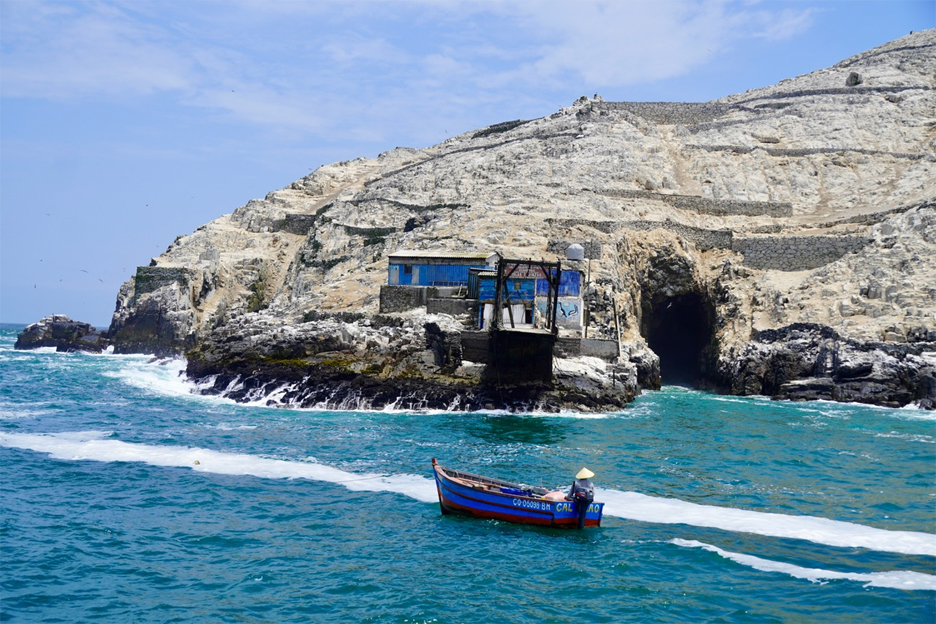
Leaving our luggage in the office of the water excursion company, Ecocruceros, we walked to a small boat that ferried us out to a larger one, holding a dozen or so eager tourists from a wide swath of the globe, and several crew. The time at sea was predicted to be between three and four hours, bringing the S.S. Minnow to mind.
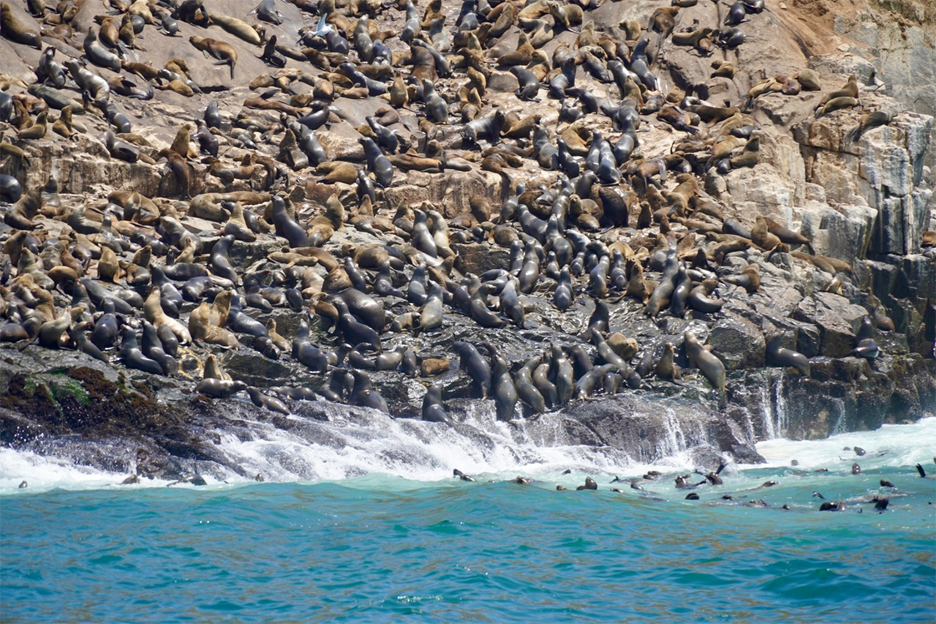
Along the way to Palamino Islets at which eight to ten thousand sea lions hang, one passes several other islands. These include El Camotal, the Peruvian Atlantis. It’s mostly submerged except during low tide between December and March. Once a vibrant agricultural community growing the sweet potatoes prized in Peru, it sank in 1746 when the earthquake and tsunami reshaped the coastline. Much more visible is San Lorenzo Island, the largest and tallest on Peru’s coast. It houses a naval base that occasionally shells part of the island for target practice. Another island is El Frontón, earlier known as Dead Man’s Island when inhabited by pirates. It became a maximum security penal colony in the 1900’s, including for political prisoners, never in short supply in 20th Century Peru.
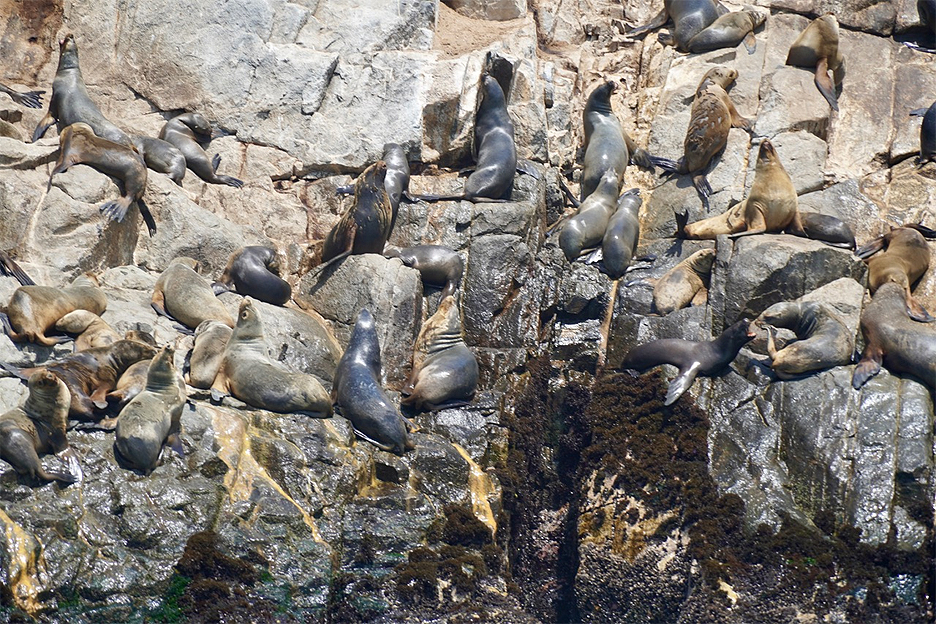
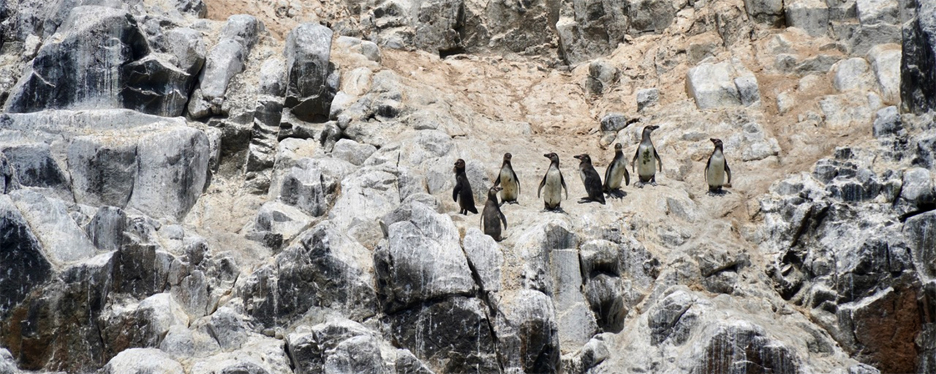
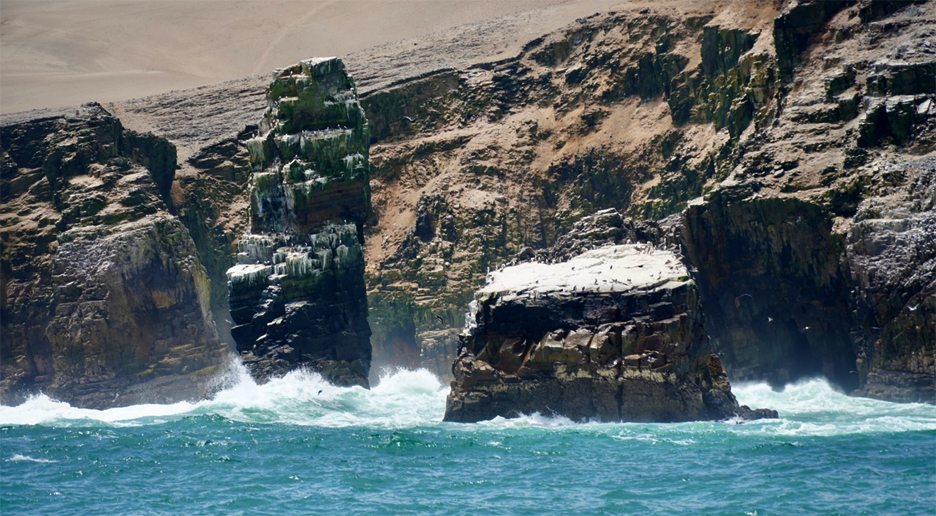
El Frontón was shut down after a Shining Path uprising in the 1980’s over prison conditions. An explosive military attack killed hundreds of prisoners. Sea lions and Humbolt penguins now come and go freely. More birds, including boobies, cormorants and pelicans join the penguins on the Cavinzas Islands, a nature reserve. There was some mining of once valuable guano for fertilizer in these islands, but nothing significant compared to the islands much farther south. Plenty of guano is apparent on the cliffs. A bucket and rope indicates someone still snitches some for a local crop.
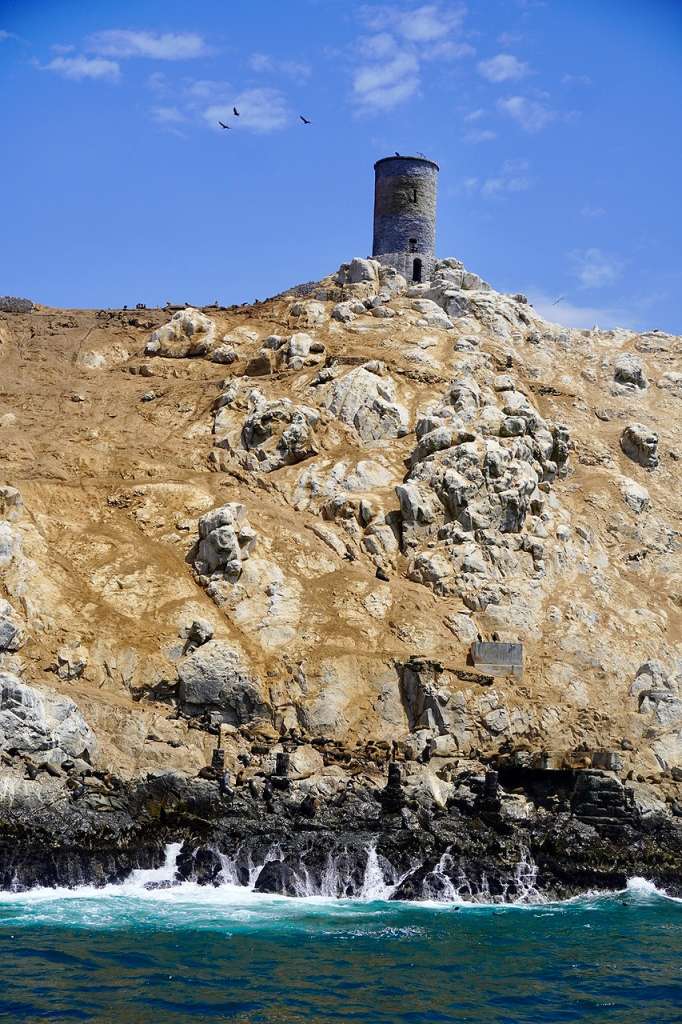
An impressive escape from El Frontón was managed by Guillermo Portugal Delgado, aka La Gringa, who used a blonde wig to disguise himself as a woman. He killed a sea lion and used it for buoyancy and disguise, and maybe the fat to coat his body, as he swam the 7km to the port. An award-winning film on the noted criminal and escape artist, Alias “La Gringa” (1991) tells the tale, elevating Portugal to folk hero status while using his life to illustrate the turbulent ’80’s in Peru.
What eventually happened to Portugal? One AI oracle says he was later killed in a shootout with police. Another says he was disillusioned that the criminal world, violent and ruined by drugs, had lost its former codes. Living with his mother, he sought and lived a peaceful life. He even worked as a security guard at the film studio, and at a cevichería seafood restaurant. Other searches yielded variations. There are no reports of his death other than the AI entity claiming the lethal shootout. And there, in a nutshell, is the reliability of AI.
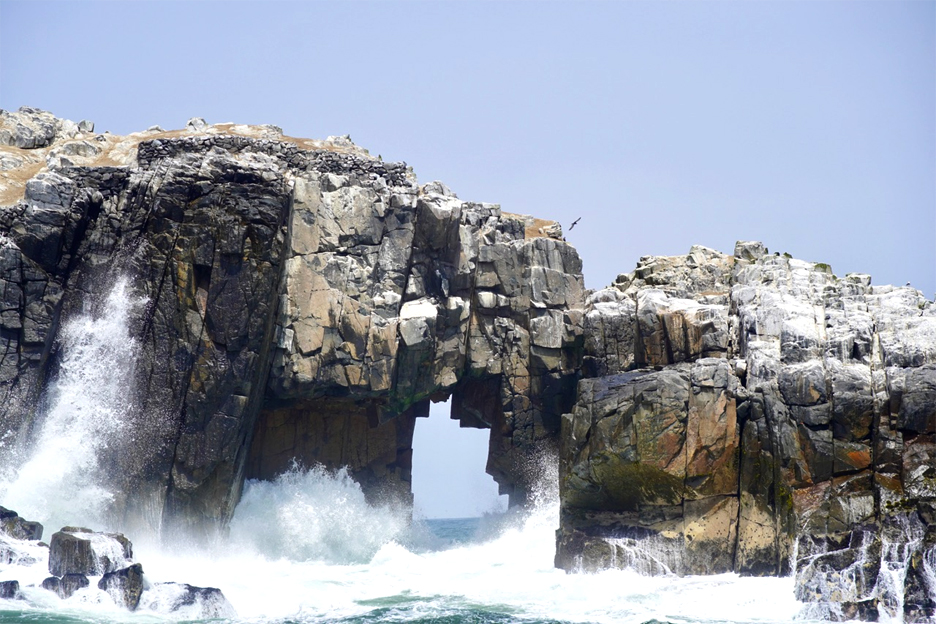
The waves in Peru’s winter, June to September, are especially rough. Most passengers accepted the offer of a seasick pill. I spurned it, staying in the strong breeze at the bow, avoiding diesel fumes, and I was fine taking my snaps.
After indulging in the fragrance of eight to ten thousand sea lions and of the bird guano waves splash into the water, on the way back I accepted a pill. Gratefully. I wouldn’t guess at the water quality but one should keep one’s mouth firmly closed. And not miss the chance to shower back at the port at the Ecocruceros facilities. Otherwise one might feel a bit ripe on a long plane ride.
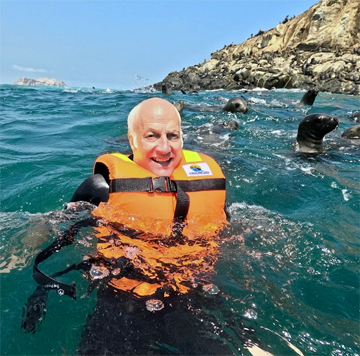
Here’s a good tip. There are wet suits aboard that cover most of one’s limbs. And suits quite short of that. Get the best coverage you can grab. The waters last October were 60 degrees F, via the Humboldt Current and upwelling from the denser deep that speeds one’s body heat away. I was late to the pile of wetsuits, and got less coverage. When I hit the water, the cold took my breath away. But no matter the size suit, those waters will always be…bracing. I heard that in Peru’s summer, December to March, the water is calmer and warmer, warmer being relative.
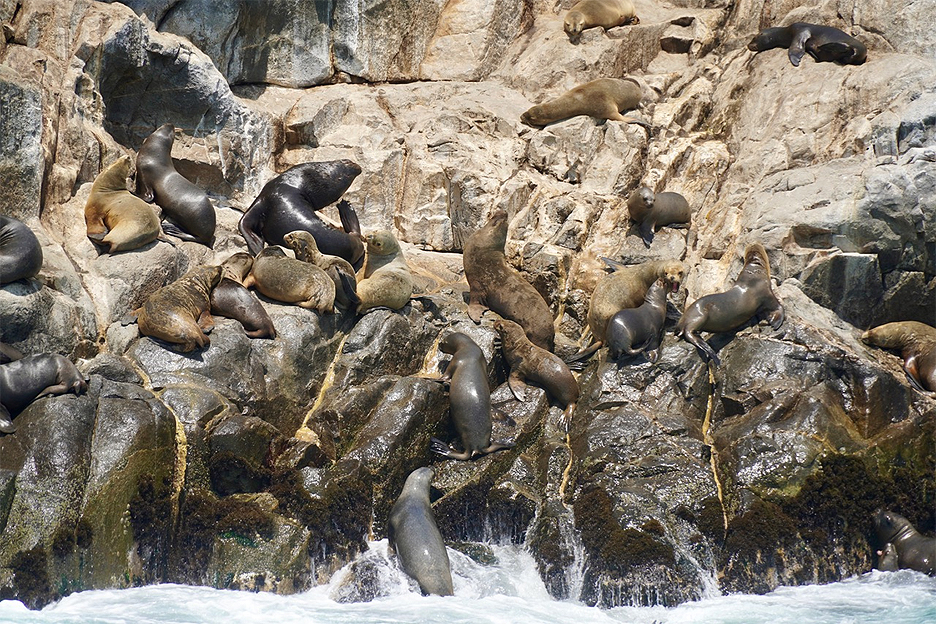
I’d never imagined seeing so many sea lions, tucked onto the rock formations and quite high on the sides of cliffs, seeming to defy gravity. Higher up and far to the side, penguins have their own private berths, both in caves and burrowed into guano, though many stand outside like sentries. Given the opportunity, sea lions will prey on the penguins, who worry most when getting in and out of the water.
After reckoning with the shock of the cold, I swam off from the boat. In moments I was surrounded by cheeky sea lions who barked their amusement as they robbed me of my comb-over. Their cacophony reminded me of relentless taxi horns early morning in downtown Manhattan. Eager to warm up by swimming fast, I swam a bit too close to the island and had to backpedal hard to keep strong waves from tossing me onto the rocks where masses of sea lions sunbathed a foot away. An alpha male with a huge head suddenly leveled his gaze at me. I quickly looked away. No offense intended, sir.
Many years back when snorkeling in the Galapagos, I caught the local alpha male’s attention by clapping my hands, not seeing a guide on a boat frantically waving for me not to. Suddenly the alpha dove in and beelined to me. He brushed my face as he sped by with his sizable teeth barred. Lesson learned.
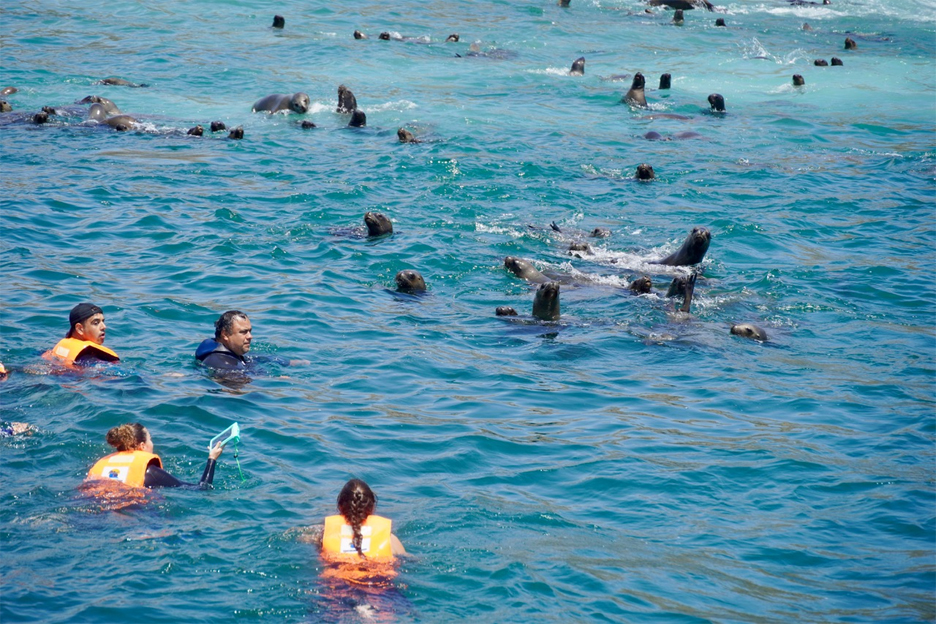
You can’t touch the sea lions but they can touch you. Leaning back onto my life preserver I lifted my feet. Curious young sea lions approached and nibbled gently on my toes. Counting them afterwards, I retained my allotted amount.
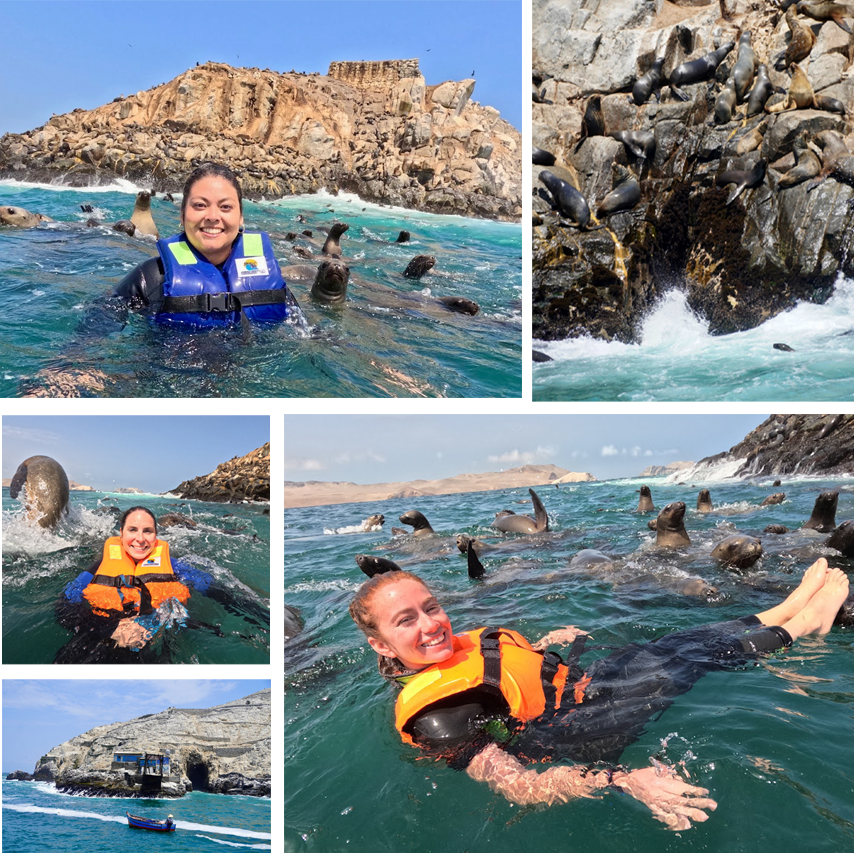
The whole experience was one of the best encounters with wildlife I’ve had. It was like being fire-hosed by nature.
Even better, I honestly felt the participating sea lions enjoyed us as much as we enjoyed them.
Upon my return to Washington, DC, I quickly contacted the eye surgeon who’d ridden me of cataracts and put in lenses that had me exchanging waves with the man in the moon. His urgent exam revealed a detached retina. He then rushed me to another surgeon who blasted away with a laser for half an hour. The inflamed scar tissue sealed the rip before liquid could enter and bubble up the retina like water under wallpaper. The eye is now well on its way back to normal, the darting imaginary mosquitos in my peripheral diminishing. At least until summer, when DC’s Asian tiger mosquitos will prove authenticity.
====================
Given the quality of the experience, the costs are quite reasonable. $69 US for adults, $59 for students, $49 for children 12 and under, plus a tax to the environment ministry and a five buck boarding fee. The guides are professional and amiable. Given the length of the cruise and how fast you’ll burn calories in the water, eat before going and maybe bring some candy bars or protein bars. Before departing to the boat, street vendors will pitch transparent waterproof coverings for cell phones that allow the phone cameras to work in water. I don’t use a cell phone, but I saw buyers argue them down to half-price, ($10?) and they appeared to work fine.



































Natasha D Causey
March 31, 2026 at 1:15 am
Wow!! These are good reads? Love the pics of smiling people, a little humor with politics ( takes the edge off), and seeing the world through the eyes of a true traveler! I wish!! But until then keep them coming Mr Skip!!
Ethan
May 4, 2026 at 12:24 am
What an excellent adventure, Ted, I mean Skip. Thanks for sharing. Good to hear you got good medical attention in time. Scary. Best.