Story and photos by the authors.
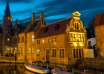
Prague, the capital of the Czech Republic is a photographer’s delight. We’ve been lucky enough this year to have had two professional guides in the Czech Republic (one in Prague and another in Brno, the second largest city in the country.) Both guides gave the same advice: Don’t come with lists with convictions you have to see certain things. The way to enjoy Czech Republic cities, they say, is to wander aimlessly and see what comes up. And what comes up is we find Prague is a beautiful old city, one of the few major European cities that was not seriously damaged in World War II and one of the few to show no evidence of the Romans.
“There is no Roman influence or presence here,” says our guide Milos Curik. “They found dense forest between Moravia and Bohemia that was too much trouble to penetrate so they didn’t come this way. The land is actually still one third heavily forested.” What we find here are ancient buildings and a lot of history. Milos, with a personal interest in arts and music, gives his top five places to visit as the Kampa Museum and its examples of Central European art under communism; the Museum of Cubism that has celebrated its presence now for a century; the Jewish museum which is really a group of five magnificent synagogues; the Lobkovicz Palace, a museum of Old Masters; and the little houses along Golden Lane in one of which Kafka wrote some of his books. Milos then sneaks in a number 6: the Cloister of St. Agnes. So when asked, Milos himself has lists.
But despite what we now know, we, too, have come with lists, places we want to see and especially photograph. And we want to start now! We have our cameras. We are ready to produce our private postcards from Prague. But we’re not ready for the surprises.

We knew we’d want to see the Astronomical Clock, Prague’s famous 15th century timepiece and we guessed correctly we’d find some tourists hamming it up below. And we were sure we’d discover more than a few references to, arguably, its favorite writer, Kafka. No surprises.

We knew of Prague’s love of music. After all, this is the country of Anton Dvorak and the city where Mozart composed two operas and conducted the first performance of Don Giovanni in Prague’s Estates Theatre. So it’s no surprise to find street musicians celebrated and plaques on the Charles Bridge given a lifetime of polish from the touch of superstitious hands. Milos also takes pains to show us the original Prague cubit, based on a metal measurement of the length of Charles IV’s forearm. The measurement has been on this door on Neruda Street for a long time: Charles lived from 1316 to 1378!

We expected to see evidence of devout Catholicism in Prague’s churches and museums (and St. Nicholas Church surely showed us that in Prague Castle) but we didn’t quite know what to make of the disconcerting statue of the skull under the robe in the Basilica of St. George at a moment when we didn’t have Milos — and none of the placards were in English. Enough to imagine the effect it would have had on minds of the Middle Ages!

We guessed we’d see couples and we did photograph some recently wedded ones. A moment later we follow a tourist with a red shirt (attracted to the color like moths to flame). He stops by chance beside an oddity – what looks like Don Quixote but we’re not in Spain.
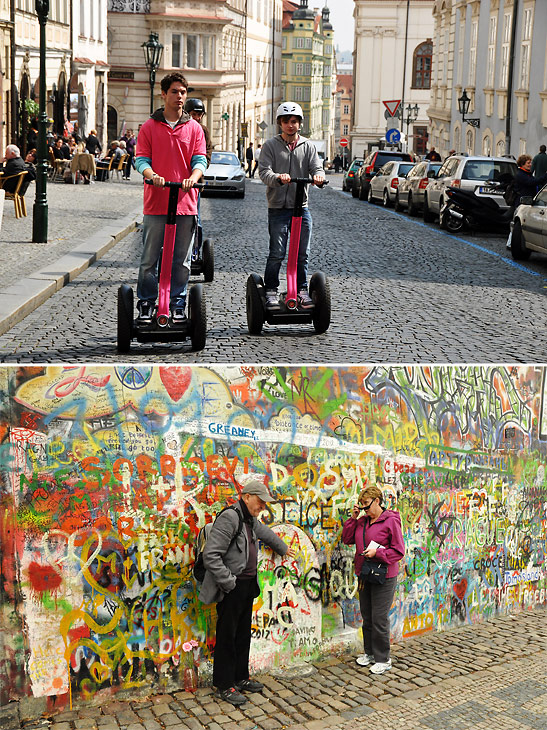
Our visit to the John Lennon Wall is intercepted by Segway tourists. Who would have thought a Dean Kamen New Hampshire invention would work so well on the cobblestones of Prague? Or that John Lennon would be so honored in a distant land? Young people in the communist era saw the popular Beatle as an anti-establishment hero and at random chose a wall right beside the French Embassy for their anti-government graffiti. The authorities kept removing the slogans until the Embassy asked they be left alone, surprisingly because somehow one doesn’t expect French institutions to have a sense of humor. The slogans on the wall are ever-changing but words attributed to Lennon are never erased even those that say “Hey! Who’s been writing on my wall?”
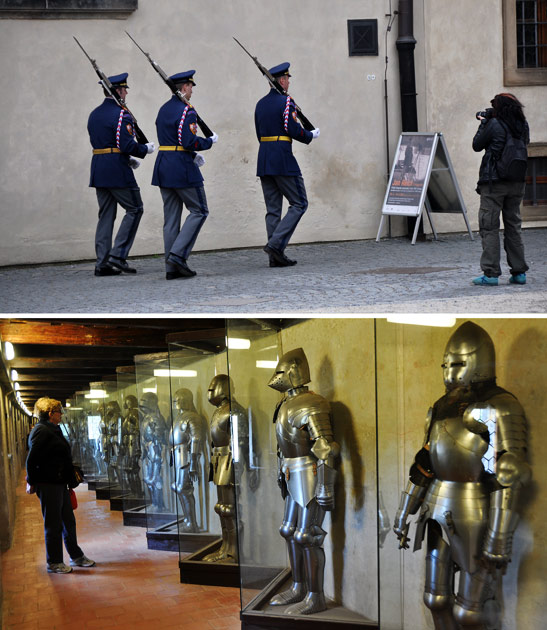
It was no surprise to find soldiers marching in a medieval city — and we were sure there would be museums of armor though we were taken aback to find one in so diminutive a Mother Goose-like village as Golden Lane especially near number 22 where Kafka’s sister lived and where he stayed to write some of his books.
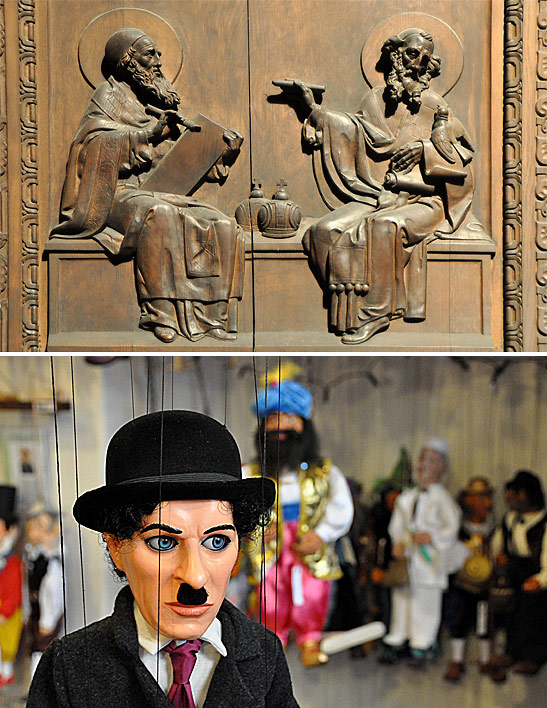
Despite having so many churches Prague is a secular city. Why would it not be; its people had suffered for centuries from religious wars? Organized religion has not been kind to this ancient city. Yet we knew we would notice beautiful wood carvings even though we might not find the story behind them. Fortunately our guide Milos spoke fluent English, fortunate because during a third of a century of communist oppression, the school children learned Russian not English and the museums don’t exhibit much in our language. So we expected church wood carvings but not Charlie Chaplin puppets.
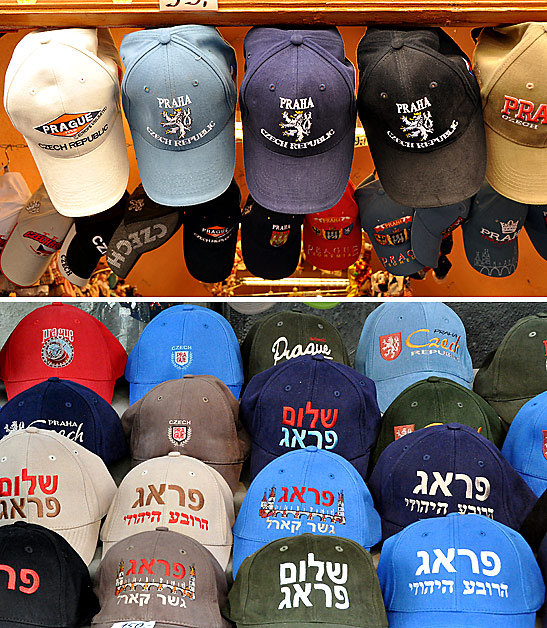
We know a variety of T-shirts and baseball caps awaits tourists in every city. No surprise to find then in Prague but, hey! Jewish baseball caps in the Old Jewish Quarter? Why not – after all there was a 1913 song called “Jake! Jake! The Yiddish Ballplayer,” and Hank Greenberg and Sandy Koufax were both Hall of Famers.
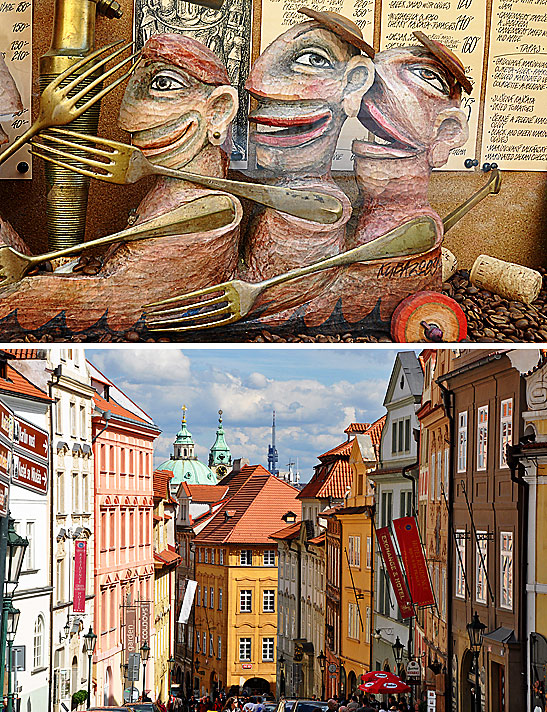
So which of our postcards surprised us? We didn’t expect to see such amusing stuff in restaurant windows in Neruda Street or that the street itself would be so beautiful, so mesmerizing. Indeed that Prague itself would be both so fascinating and such fun.