Johnny Otis (born on December 28) was one of the most versatile and prolific musicians of the 20th Century. He not only sang and played a variety of instruments but led his own band, and made his name as a songwriter, producer, club owner and talent scout. Otis managed his own record label; became a distinctive voice in L.A. radio and hosted a long-running music and dance program in the early days of television that predated Dick Clark’s ‘American Bandstand.’ And that just barely scratched the surface…
Welcome to the Johnny Otis show!
If ever a musician could honestly say, ‘been there, done that’ my money is on a man named Johnny Otis. Otis was born Ioannis Alexandres Veliotes to Greek parents in Vallejo, CA the last month of 1921. Not long after, the family moved south to Berkeley where ‘Johnny’ Veliotes spent his formative years in the surrounding Bay Area neighborhoods. Leaving school to focus on music, Johnny’s primary education fell under the tutelage of a host of veteran musicians from several of America’s best known black ‘territory bands.’ It would be those years of musical experience and life lessons that would help shape both his character and his career.
Johnny Otis did it all; a multi-talented performer who sang, played drums, vibes and the piano. He was a bandleader, songwriter, producer, promoter, club owner, talent scout, and publisher. At one time, he managed his own record label, worked regularly as a radio disk jockey and hosted a long-running music and dance program in the early days of television that predated Dick Clark’s ‘American Bandstand.’
Johnny Otis was inducted into the Rock & Roll Hall of Fame in 1994 the same year he received the coveted Pioneer Award from the Rhythm & Blues Foundation. The Blues Hall of Fame engraved Otis’ name onto their honor rolls in the year 2000. Never a person to rest on his laurels, Johnny Otis became a noted author and columnist, worked tirelessly as a civil rights advocate, even threw his hat into the political ring. He became an ordained minister, was literally a walking encyclopedia of music and history, eventually teaching at the college level, and was widely known in the world of fine arts for his paintings and sculptures. Johnny Otis was truly a man of Arts and Letters. He led an amazing life especially when you realize that it all began with just a promise and a pair of drum sticks.
“The reason I started playing drums” Johnny said, “was in Berkeley, California I had a friend who actually lived in Oakland, and we used to see each other, just childhood buddies, you know when we were teenagers?
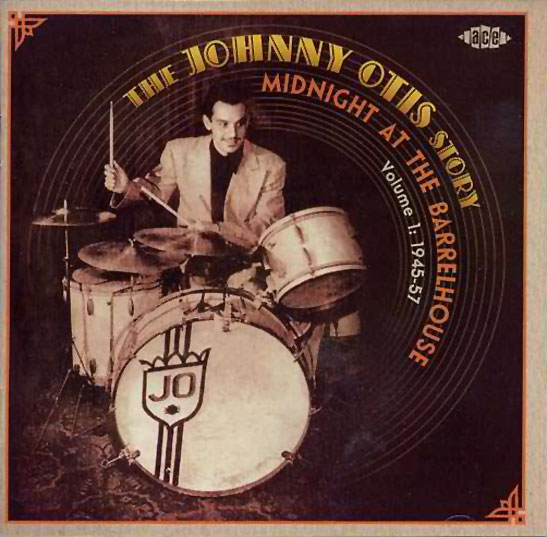
Midnight at the Barrelhouse Vol. 1 Album Cover on ACE Records
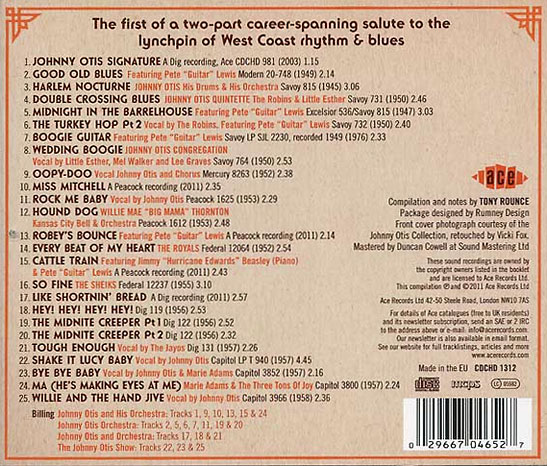
Midnight at the Barrelhouse Vol. 1 Back Cover discography
His name was Otis Matthews, we called him ‘Count’ Otis Matthews because he played the piano. He didn’t play like Count Basie, though. His family was from the Mississippi Delta area and he was a boogie-woogie blues barrelhouse player and singer. So Count Otis told me once, ‘I’m gonna’ get a band together and you’re gonna’ be the drummer.’ I said, ‘Oh yea!’ And we did.
We found some old raggedy drums and he told me the main thing you have to know. You’re all excited about the Count Basie swing and the Gene Krupa and the Jo Jones, but there’s one number I want you to play my way when we come to it. ‘You just play shave and a haircut, six bits.’ I said, ‘What’s shave and a haircut, six bits?’ He said just go, (Johnny raps it out on the table)‘ Tap, tatatap, tap…Tap Tap. And don’t vary it. And I’m gonna’ sing.’ And that was my first experience with that beat which later became ‘Hambone’ and ‘Bo Diddley’ and ‘Hand Jive.’ So, little by little, I was playing the drums, I thought.”
The Road Beckons
Do you remember your first paying gig? “A man named Robert Johnson took Count Otis and myself and we went to Reno, Nevada to play a job. This was in the ’40’s and the job, the man offered us $45 a week. My God, that was twice as much as my father was making at the time. So we got an old, raggedy car and went to Reno, Nevada but when we got there it was $45 for the three of us! Which was still about what my dad was making! (laughing) We played from seven o’clock in the evening to 4 o’clock in the morning every night. The man said don’t worry though, you’ll make a lot of tips. We never made a penny! It was a little funky place, they were trying to be a casino, but there was nothing. And we lived there. The man owned the hotel, so we stayed there and ate there. And at the end of the week, he’d take the rent and the food out, and we owed him $15 apiece!
So we left there in the middle of the night and went to Denver, Colorado. And that’s where I joined George Morrison’s Band. That was the first real PROFESSIONAL, professional job. And from George Morrison, I went to Lloyd Hunter, which was really a wonderful thing because it was one of the black territory bands of the day and they played the Count Basie, Jimmy Lunceford, Duke Ellington, Benny Goodman kind of stuff, so that was a great experience. I stayed with Lloyd Hunter until I was called by Harlan Leonard of the Kansas City Rockets to come to L.A. and be their drummer and that’s how I got to L.A.”
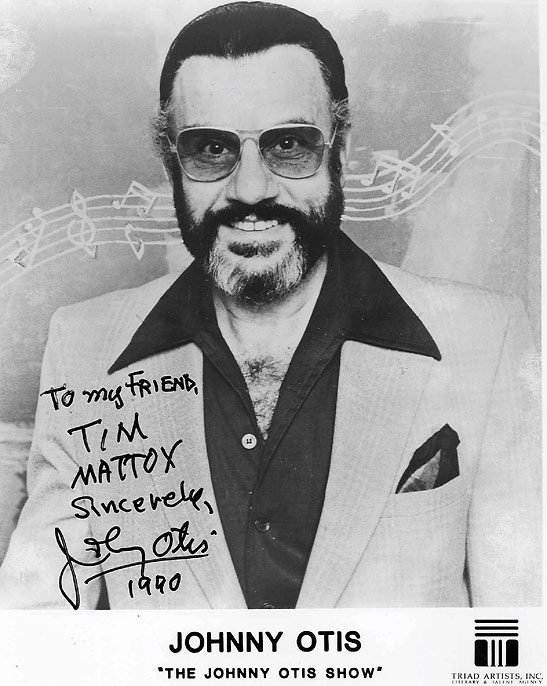
“In L.A. at the Club Alabam, the man who owned it took a liking to me and when Harlan Leonard’s engagement was finished he let me be the band leader and I got my big band together. And since that time, that would have been 1943, I’ve had a band of my own.”
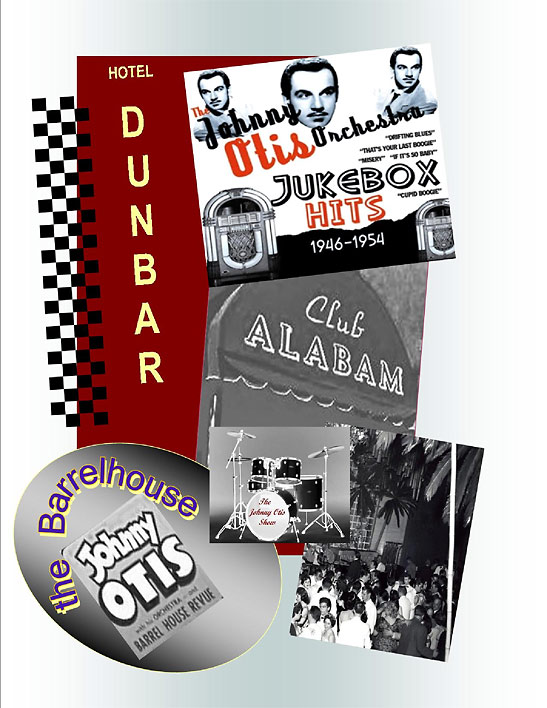
Central Avenue and more specifically, the Club Alabam located next door to the Dunbar Hotel at 42nd and Central was the Mecca for all things music in Los Angeles. On any given weekend you might spot Duke Ellington, Louis Armstrong, Billie Holiday, Miles Davis, a host of Hollywood celebrities or even ‘The Brown Bomber’ heavyweight boxing great, Joe Louis. Central Avenue in the 30’s and 40’s was THE place to be.
“The Club Alabam was our Cotton Club West.” Johnny said. “There’s been a lot of advertisement about the Cotton Club but what people don’t understand is Central Avenue, the African-American community of Central Avenue was our Harlem Renaissance transplanted to the West Coast. The Club Alabam was a big cabaret, large with a big balcony around it, a big stage and a great big dance floor that doubled as the stage when the floor shows came on twice a night. It was wonderful. It was full scale chorus girls, ‘soubrettes’ and that name has been lost. It means the leading chorus girls, those that did the specialties. Showgirls who did nothing but just parade with big costumes on and chorus girls of course danced and we had the big band there. The stars of the day came through and they were featured. ‘Moms’ Mabley, the Peters Sisters, the Step Brothers. And at that time these were great artists and I got the chance to play with them.”
“We combined swing, a little bit of bop and country blues and put it together. It was later to be called, ‘Rhythm & Blues.'”
— Johnny Otis
“From the Club Alabam, a man came in; he heard us and recorded us. And THAT day, we caught a hit record. But it was a happy accident. It was my first record date and Count Basie loaned me Jimmy Rushing to sing with me. He gave me some arrangements so I could come off well. So we went in and we recorded and we were very well rehearsed. I went into the control room, and I say, ‘Well Mr. Rene, That’s it baby, I did ’em. Three sides and the four hours aren’t even up yet.’ He says, ‘No, you’ve got it wrong. It’s four sides in three hours.’ He says, ‘you’ve got about twenty minutes to do one more.’ So I went in the studio and the guys are putting their horns away, I say ‘wait, wait come back, we’ve got to do another one. So when we came back, I remembered at the Club Alabam I had a stock arrangement, a song that had been recorded once by Ray Noble but done in an entirely different manner. And we put a jungle rhythm beat to it. And the chorus girls would come out on the balcony and shake and dance ’cause they liked it. I say, ‘let’s do that.’ And we did and THAT was the hit. The other things didn’t even mean much at all. It was a happy accident and that got us started.
The song was ‘Harlem Nocturne.’
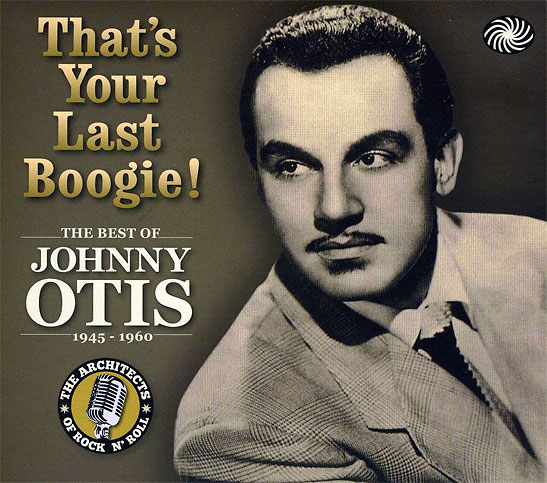
The Best of Johnny Otis album
“We traveled for a couple of years all over the country including an original INK SPOT tour, with the real INK SPOTS. And then I came back home about 1947, it was just about finished for big bands, the Big Band thing. I broke my band down to a smaller band; most of us did, and opened a place called The Barrelhouse. We decided we would do strictly blues, of course we didn’t know it but by breaking our bands down from big bands, and that included myself and T-Bone Walker and Joe Liggins and Roy Milton we were actually creating a new style, but we didn’t know it. (laughing) Rather than eight brass I had now only one trumpet and one trombone. Instead of five saxes, I had just two, a tenor and a baritone. But that striving to maintain some semblance of a big band actually brought a whole new flavor and new sound. We combined swing, a little bit of bop and country blues and put it together. It was later to be called, ‘Rhythm & Blues.’
The Godfather of Rhythm and Blues
Johnny Otis is often referred to as the ‘Godfather’ of Rhythm and Blues. When asked about the title, he just shook his head. “I’m embarrassed by that, because all the great brothers and sisters through the years who contributed to that. My agent says, ‘shut up and take it.’ (laughing) But I can’t, it’s dishonest. I was part of it, but surely not the leading figure.”
As humble as Mr. Otis was, very few can doubt his innate ability to find raw talent, guide them through the studio process only to walk out weeks, sometimes just days later with a highly polished recording and more often than not, a chart single or two. That list of artists’ stretches across generations and genre’s, but to give you just a taste… Etta James, Jackie Wilson, Little Esther Phillips, Big Jay McNeely, and Big Mama Thornton.
He relents “Yeah, I know I did that. When the big band thing died and we broke it down, I opened the Barrelhouse out in Watts. We decided to go strictly blues, no sophisticated jazz arrangements…just blues. And a certain kind of comedy they used to have in the theaters back East, like the Apollo. It was a success from the first day; the place was packed because the people of the black community were interested in what can probably be described as their ‘folk music.’ That kind of blues… not the deep country blues and not the sophisticated jazz blues, but in between; a thing that was to be called ‘Rhythm and Blues.’ This is what they liked and this is what we began to evolve with. We recorded again and this time I caught big hits with Little Esther Phillips and we were on the road again.”
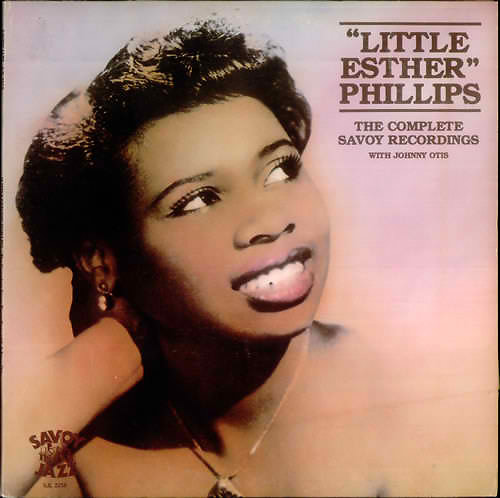
The Savoy Collection
Little Esther became a recording phenomenon from the very start in the 1950’s, scoring two, No. #1 hits on the R&B charts. Tell us how you first met her? “Just before Esther passed away, I was pastor of the Landmark Community Church and at that time Esther was one of our members. She was having problems with alcoholism and with drug addiction and she would come by. And one day there was a young man, like yourself, who was interviewing us at the church and he said, ‘now when did you first meet Esther? Just as you just asked me. And Esther was there, of course. I said, ‘Well I met her at the Largo Theater when she was thirteen years old, I heard her singing.’ She said, ‘No, That’s not the first time.’ Now this was so many years later and I had it backwards. I said, ‘What do you mean?’ She said, ‘The first time you met me was in your backyard, at the chicken ranch where you had the chickens.’ So, what I had was, in Watts at night I ran the club, The Barrelhouse…In the daytime I had the Progressive Poultry Company!” (laughing) “And I raised chickens. My bass player and I had a couple of old ice cream trucks and we would deliver and people would come. The Watts folk would come, you know Southern people want to pick the chicken out.” (he points) “That One! And here’s a pen twice as big as this room, with two hundred Rhode Island Reds in it, and the lady says, ‘I want that one.’ Well (Otis is shaking his head) they ALL LOOK ALIKE…they’re CLONES! But I had these little kids who would run and catch them for me, but mostly they’d miss, get another one. And Esther said, ‘I was ONE of THOSE kids!’ I said, ‘REALLY?’ She said, ‘I even sang for you.’ And suddenly I KNEW who she was, because we had just finished catching chickens and selling them and there was a lull. It was a hot summer day and we sat under these eucalyptus trees and the wife brought us some Kool-Aid and some cookies and we were just taking a rest and I heard a little girl sing around the tree, singing like Dinah Washington. I said, ‘Who is that?’ And they said, ‘Her!’ And she was a beautiful little black girl with bright eyes. I said, ‘Come here, honey. Was that you?’ She was about, I don’t’ know eight, maybe? She said, ‘yeah.’ And I hugged her. I remember that, but I didn’t place that person as being Esther Phillips who I found later at that talent show at the Largo Theater. She never forgot it. And I didn’t either; I just didn’t realize it was her.”
Do you ever feel that you have some special skill or ability to recognize talent in others? “You know, I’m really thankful about that because I seem to be able to see something out on the horizon, early. I’ll explain a couple of instances to you. One day in Cincinnati at the Manse Hotel where we used to stay, I was out on the porch waiting for my guy to bring the car around. We were going to go to King Records which was stationed there. I was under contract with them at the time and they had a recording studio and a young Ray Charles was sitting there too. He was a piano player with Lowell Fulson at the time. He said, ‘where you going Johnny?’ I said, ‘I’m going down here to King.’ He said, ‘Take me with you, I wanna’ go over there and try out.’ I said, ‘Come on, I’m a producer there.’ And I loved him, ’cause I’d heard him play and sing. We go by there and I told Syd Nathan, I said, ‘Syd, I got a young kid here you gotta’ hear this boy play the piano and sing, he’s marvelous. Okay, so they set him up the studio and Syd Nathan and I and a few of his henchmen sat on the other side, you know in the control room. And Charles started singing and playing and he sang very much like Charles Brown in those days and Syd turns to me and says, ‘I don’t need any poor man’s Charles Brown, forget it.’ And he walked out. But a few years later when Ray Charles was just setting the world on fire, I saw Syd Nathan, but he refused…he said, ‘WAS NOT!’ I said, ‘Yes it WAS, it was Ray Charles.’ (laughing)
The same scenario unfolded with Esther Phillips when visiting RCA Victor in Hollywood and Johnny got a similar response. “That’s a poor man’s Dinah Washington, who needs that? And Esther became a big star.” Johnny’s laughing and he leans toward me and says, “I took ETTA JAMES’ record to someone and in that case they just weren’t interested. They didn’t hear anything in her voice.”
I’m not the sharpest tool in the shed, but you would think people would start paying attention? They finally did after one very special talent show at the Paradise Theater in Detroit. “On THAT day I found Little Willie John, Hank Ballard and the Midnighters and Jackie Wilson. That night, by the way I remember that Jackie Wilson… I heard something in him, that gospel, wonderful flavor. I knew that they were not going to be interested in him singing ‘Danny Boy’ and ‘My Buddy’ and ‘Trees.’ This is the way he sang then, so I wrote him a little blues ballad and he sang it for them (King Records) the next day. But they didn’t like him, so they gave it to the Midnighters and the ballad did nothing. But ten years later, Gladys Knight recorded it and it became her first big hit, ‘Every Beat of My Heart.’
Speaking of writing…tell us about Etta James and ‘Dance with me, Henry.’ “Roll with me, Henry it was originally.” Johnny corrects me. So why did you change it? “I didn’t change it. I wrote it as ‘Roll with me, Henry’ it was Etta James’ idea. That was her song, but all she had was that phrase. And she had Hank Ballard’s ‘Work with me, Annie’ melody. Johnny breaks into song, ‘Roll with me, Henry. Roll with me…’ So I wrote a whole song to it, and Hank Ballard and I and Etta James became partners. But it meant dance with me, but somehow the people they got edgy about it. It’s too sexy. I said, listen to the words, ‘get the lead out of your feet, come on learn some dancin’ if you want romancin‘ but they said ‘no, we better change it, they’ll think you’re talking about sex.’ So they changed it to ‘The Wallflower.'” (Otis laughs) “What a crock! And then later, what’s her name uh, Georgia Gibbs they were still uneasy and they changed it to ‘Dance with me, Henry.’ Which is what it meant anyhow…Fine.”
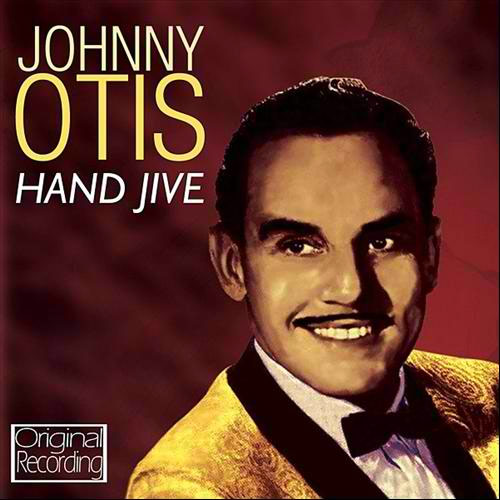
Let’s talk a little about 1958. It turns out to be a pretty good year for you. You release the song, ‘Willie and the Hand Jive.’ “Yeah, a man named Tom Morgan who was my producer, if it were not for him…because my manager didn’t like ‘Hand Jive.’ He had been in England setting up a tour as a result of a hit record we had at Capitol called, ‘Ma, He’s Makin’ Eyes at Me.’ But it was a hit only over there, in England, and South Africa and Australia; all the British Empire places. When he came back he said, ‘Hey, the tours set BUT I saw something, the British kids sitting in these venues where they can’t dance…theaters and concerts. And they’re doing what you guys in the old black bands used to do.” Johnny starts slapping his hands together. “They’re doing that stuff with their hands and they call it hand jive. Write a song called ‘Hand Jive.’ So I did and we had a meeting, Tom and I and Hal and Hal hated it. He said, ‘That’s terrible and he tore it up and threw it in the waste basket. But Tom Morgan picked it out of the waste basket and said, ‘You’re crazy, that’s cute.’ And he put it out; he overruled him and put it out. Thank God, because we almost lost a hit record.”
If you listed the number of musicians and singers that Johnny Otis has written, recorded or played with over the years, it would read like the Index from the Encyclopedia of Rock, Jazz and Blues. But there is one legendary saxman that always put a smile on Johnny’s face. His name was Eddie Vinson, friends just called him ‘Cleanhead.’ Johnny starts to laugh and says, “Oh yeah, my baby.” He continues to laugh as he remembers a particular show in Canada. “I don’t think alcoholism is funny at all, (still laughing) it’s tragic. In fact it contributed to Eddie leaving us prematurely. But some of the things he’s done. (laughing) He and Joe Turner and T-Bone Walker were my featured artists on the show for a long time. Once in Montreal, I announced him, ‘Ladies and Gentlemen, a great man of American Music. A person who transcends many lines… Rock and Roll, Rhythm and Blues, Swing, Jazz. The one and only, Mr. Eddie ‘Cleanhead’ Vinson.’ And I look over at the spotlight and he’s not there. And people are laughing. I’m saying to myself, ‘they’re laughing at me, because he hasn’t shown up.’
But, he was so intoxicated he couldn’t walk. He was crawling and when he went by me, he gave me the salute. He got to the stool, and crawled up on the stool and I said, ‘Oh my goodness.’ He had the ability, no matter what his condition was, to sing and play. You’d never know; he wasn’t impaired that way. I don’t recommend it, and I’m not laughing because it’s funny….but that surely happened.”
I mentioned that I’d talked to Mister Cleanhead not long before his passing at his house in South Central L.A. Johnny nods and informs me. “He (Vinson) lived next door to a very historic place. It’s no longer there. Ivie’s Chicken Shack. Back in the 40’s it was a beautiful art deco restaurant called Ivie’s Chicken Shack. It was Ivie Anderson’s restaurant. I always think of that when I think of where Eddie lived.”
How did you get to know Sam Cooke? “Sam and I belonged to the same church. This was back in the 50’s. It was a big church in the West Adams area in Los Angeles. And it was about a 2000 capacity and the church is full one Sunday morning. We’re sitting there and the preacher, as most preachers with his commercial sense, we were very well known at the time. So he pointed us out and had us take a bow, which was embarrassing to begin with, and then he made a remark. The preacher said, ‘Brother Johnny and Brother Sam have been out there doing what they do, but one of these days they’re gonna’ stop playing the devil’s music and come home.'” (Johnny laughs) “Sam looked at me and he whispered, ‘Did he REALLY say that?’ I said, ‘Yeah,’ and we both resigned on the spot.” (laughing) “The idea that something as beautiful as what Sam Cooke does, or Ray Charles or Aretha Franklin, being described as the devil’s music… The preacher felt that it was competition to him, that’s what it really was, they knew better. All of them couldn’t have been that ignorant.”
Anybody you didn’t have the chance to work with that you wish you had? “You know who I like, Big Maybelle. I would have loved to record Big Maybelle, but we never did, of course.”
As you reflect on your journey so far, you’ve spanned the music industry spectrum, producing and performing in multiple styles and genres over all mediums; recordings, radio, television, and now even the written word… “Its luck…its luck. Sometimes when something nice would happen to me I would say, ‘Imagine this happening?” And there are people on every corner who have a thousand times as much talent as me. But you just have to be lucky and be in the right place at the right time.”
I could maybe agree to ‘the right place at the right time’ scenario IF Mr. Otis had been a one hit wonder or had just one successful venture into the music business. But this is the same man who once had Ten, Top 10 songs on the Rhythm and Blues charts in a single year. I must repeat…Ten R&B Top 10’s in one year!
Johnny Otis’s phenomenal music career mirrored America’s coming of age during the 20th Century. As thousands came home from war the 1940’s witnessed the nation’s long awaited and euphoric transition back into peacetime. The country was ready to celebrate and with pockets flush with back pay, John Q. Public let the good times roll. The Swing Era of the Big Bands had reached its zenith and a musical shift began to change the tempo. Otis, along with his peers and fellow musicians created, produced and recorded something fresh and innovative that reflected that national attitude. According to Johnny, “It contained the blues element that was the most important feature, or course. And boogie woogie piano and twangy electric guitar. But in addition it features horn sections very often… and echoes of swing riffs, even bebop riffs and gospel music, you know? So you put all of that together and you have the classic Rhythm and Blues that was born and nurtured in L.A. and New Orleans. New Orleans is a very important incubator for the Rhythm and Blues sound.”
Yet, Johnny Otis continued to push the boundaries and seek out and mentor new talent. His groundbreaking work with Big Mama Thornton, Johnny Ace and Little Richard would eventually be recognized for what it was, the early stages of an even edgier sound. Hindsight being what it is, when you listen to some of those early Savoy tracks like ‘Rockin’ Blues’ or ‘Little Richards Boogie’ and ‘Hound Dog’ on Peacock, it becomes immediately obvious that those are without question, some of Rock and Roll’s earliest heartbeats.
Although we lost Johnny Otis a little more than a year ago, his legacy and music lives on through every artist he introduced and every side that he recorded. Thanks for sharing Johnny, we sure do miss you.