ASK MISTER ROBOT is Traveling Boy’s Q & A about a variety of topics that keep people awake at night. The answers come from Mr. Robot, an AI model, who scours the internet for answers. Don’t take his answers like gospel truth, rather consider his answers as an educated opinion. We welcome your questions and invite you to join in the conversation.

The WNBA has a straightforward rule on its face: only women are eligible to play in the league. But the controversy surrounding the league’s eligibility policy exposes a basic question that the WNBA has not publicly answered: What exactly makes someone a “woman” for purposes of WNBA eligibility?
That question matters because women’s sports exist for a reason.
Why Have Women’s Sports?
Men and women are not identical from an athletic standpoint. After male puberty, males generally develop greater muscle mass, strength, bone size, height, lung capacity, hemoglobin levels, speed and explosive power than females. The size of these differences varies by individual and sport, but they are particularly relevant in a sport such as basketball.
This is the fundamental rationale for maintaining separate men’s and women’s sporting categories: without some form of separation, female athletes would generally be competing against a population with physical advantages that could make competition substantially less fair.
That doesn’t mean every male athlete is better than every female athlete. Individual talent obviously matters. It means that sex-related physiological differences are sufficiently significant at the population level that sports organizations have traditionally created a protected women’s category.
The question today is how that category should be defined.
What Does the WNBA Rule Say?
The WNBA’s collective bargaining agreement with the Women’s National Basketball Players Association states:
“Only players who are women are eligible to play in the WNBA.”
That seems clear—until we ask what woman means in the context of athletic eligibility.
The CBA provides detailed requirements concerning age, college eligibility and draft qualifications. Yet it does not publicly specify whether “woman” means biological female, female at birth, legal female, gender identity, or some physiological standard.
That creates a significant ambiguity.
Is Simply Claiming to Be a Woman Enough?
Recent events suggest that it is not.
In August 2026, former NBA players Enes Kanter Freedom and Royce White announced their intentions to enter the 2027 WNBA Draft while identifying as women. They were subsequently reported by the Associated Press and other outlets as being deemed ineligible for the WNBA draft. The league has not publicly explained the specific reason for the determination.
This is where the issue becomes particularly difficult.
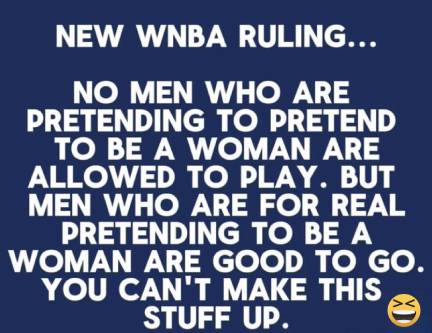
If identifying as a woman were sufficient by itself, then a male athlete could presumably satisfy the WNBA’s stated requirement simply by making that declaration.
But the recent decision indicates that self-identification alone is not sufficient.
So what additional requirement exists?
The publicly available CBA doesn’t say.
The Subjectivity Problem
This does not necessarily mean that WNBA officials are making decisions based purely on personal opinion. There could be an internal policy, administrative procedure or legal interpretation that isn’t publicly available.
But from the standpoint of someone trying to understand the rules, there is a legitimate problem.
The league has established the category—women—without publicly establishing the objective criteria for determining who belongs in that category.
That creates the possibility of inconsistent or subjective application.
Consider two hypothetical applicants.
Applicant A is biologically female and identifies as a woman.
Applicant B is biologically male, identifies as a woman, and claims that gender identity should determine eligibility.
If both simply meet the publicly stated requirement of being a “woman,” the CBA itself does not tell us why one should qualify and the other should not.
The WNBA’s recent treatment of former NBA players demonstrates that the league does, in practice, draw a line somewhere. But the public has not been told precisely where that line is or what objective test determines it.
That is the real policy issue.
This Isn’t Necessarily an Argument Against Transgender Athletes
It is possible to recognize transgender people’s dignity and rights while still asking a legitimate question about athletic eligibility.
Gender identity answers one question: How does a person identify?
Competitive eligibility answers another: What criteria should determine who participates in a protected sporting category?
Those questions don’t necessarily have the same answer.
If the purpose of the women’s category is to protect competitive opportunities for biological females, then the relevant question may involve physiological characteristics rather than identity alone.
If the league instead believes gender identity should determine eligibility, it can make that policy explicit.
What is difficult to defend is having a rule that says only “women” are eligible while leaving the public uncertain about what that word means when the league actually has to make a difficult eligibility decision.

Why Doesn’t the NBA Have the Same Problem?
The NBA doesn’t face the same classification issue because it does not operate a protected women’s category.
An NBA player generally doesn’t have to demonstrate that he satisfies a definition of “man” before being eligible to play.
The WNBA is different precisely because it is a women’s league. Its competitive purpose requires the league to establish some boundary around the women’s category.
That boundary should therefore be clear enough that athletes can understand the requirements before they attempt to enter the league.
The Question the WNBA Should Answer
The WNBA has every right to establish eligibility requirements through collective bargaining. Its current CBA does exactly that by restricting participation to women.
But the league should also be able to explain what “woman” means in this particular sporting context.
Is it biological sex?
Is it gender identity?
Is it sex at birth?
Is there a physiological threshold?
Is there a separate rule for transgender athletes?
Or is there another criterion entirely?
As of now, the publicly available governing documents don’t provide a clear answer.
That doesn’t prove that the WNBA has no internal standard. It does mean that the standard is not transparent to the public.
And transparency is especially important when the distinction determines who can compete in a professional women’s league.
The debate over transgender participation will undoubtedly continue. But beneath the politics is a much simpler principle:
If an organization creates a protected competitive category, athletes should be able to know objectively what qualifies them for that category.
The WNBA has told us who is eligible—women.
The unresolved question is how the league determines who qualifies as one.