Veterans Day gives us the opportunity to both thank and honor our men and women who have served this country in uniform. On this special holiday it’s important to remember the sacrifice each member of the Armed Forces readily accepts in service to our nation. If you take the time to explore the musical honor roll you’ll find it filled with legends in every branch of the military.
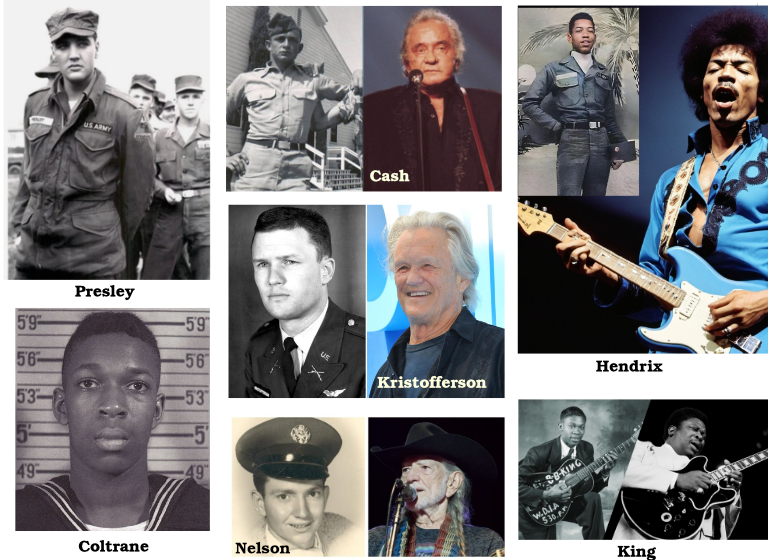
Everyone remembers Elvis in the 50s wearing his Army fatigues, but I was fascinated to find that both Johnny Cash and Willie Nelson spent their active duty days in Air Force khakis. It’s pretty well-documented that during the early 60s, guitarist Jimi Hendrix was an Army paratrooper with the 101st Airborne Division (Screaming Eagles) at around that same time, Kris Kristofferson was flying helicopters as a Captain in the Army Rangers. If you’re a long-time fan of Jazz and Blues you probably knew that the legendary sax player, John Coltrane wore Navy bellbottoms during World War II. But did you know that bluesman Chester Burnett also served during the war? Burnett not only served, but spent a large portion of his military time with the Army’s historic 9th Cavalry Regiment. Sir, Yes Sir! Howlin’ Wolf was a Buffalo Soldier!
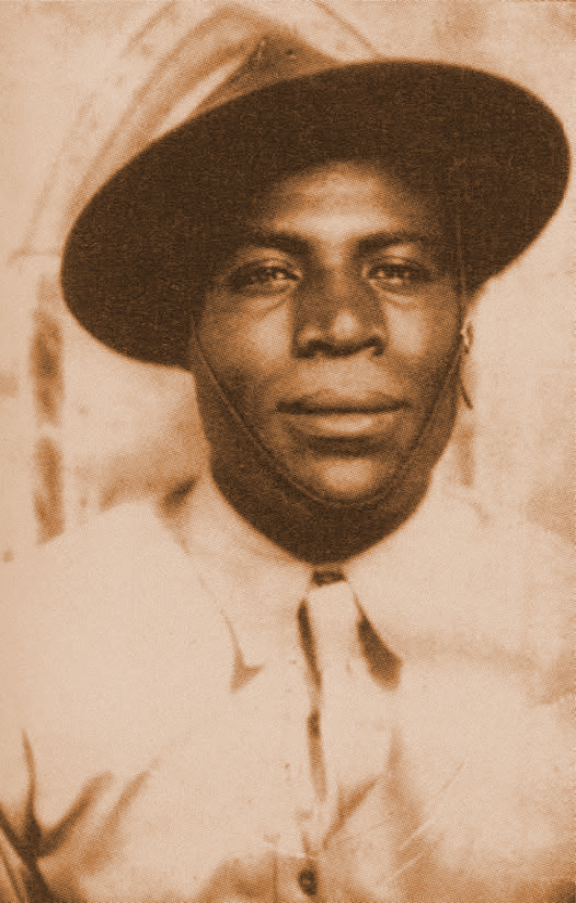
As a journalist, you get to ask people a lot of questions. The ‘Who, Where and How’ things happen usually include early influences, family, friends and the occasional chance meeting or lucky break. But it’s the Why’s and the ‘What the…?’ of a person’s journey that can leave you slack-jawed and direct you down a completely different path. Military service-whether voluntary or the surprise postal “Greetings!” from your local Draft Board-certainly qualify for the latter.
In conversations with musician friends and artists over the years, I’m often awestruck by revelations of past military experiences. B.B. King is one of my personal favorites. When I asked him about serving in the Army during WWII, he laughed and shook his head. “Only a short time…Let me tell you this and I have to apologize to all the service people. I only served when I went into basic training and at that time I was on the plantation. So when you’re on the plantation like I was, we were raising produce and things for the Armed Forces. They told us at that time that what we were doing was equally important. But if we left and stopped doing it, we’d be re-classified. So a lot of us kept doing it. I went in for basic training in ’43. I became 18 in ’43 and short of the full basic training which was usually 3 months, we did 2½ months. Then they re-classified us and they sent us back and I started driving my tractor again. And I drove it till the war was over…when the war was over, that’s when I left and went to Memphis.” I commented that everyone knows the Army runs on its stomach, so in essence you were essential personnel. “Even if I died tomorrow,” B.B. shook his head and started to laugh, “I wouldn’t get a flag!” (Service Commendation Award)
In the 1940s World War II instantly spread blues music to International shores. When you think about it, it’s impossible to not experience ‘the blues’ when you’re far from home, missing the ones you love and then there’s that little matter of having a country full of people you don’t even know, trying to kill you! That pretty much is an ultimate mood breaker.
James ‘Snooky’ Pryor – United States Army
Chicago harp legend, James ‘Snooky’ Pryor witnessed war up close and personal when serving in the South Pacific. “I was on Noumea, New Caledonia. I was on Saipan, Tinian; I was on Guam and Eniwetok.” Pryor was assigned to the “362nd Engineers and 267th QM Company, and was attached to the 24th Infantry when I came home.” Headds, “I was a bugler.” He starts to laugh when he told me after TAPS every night “and not too close to the front line” they would leave the Army PA system hot and he would break out his harmonica and blow some of those mournful, moaning deep blues through the dense, jungle battle lines. You just know, that had to create a major pucker factor for the enemy fighting forces. Sitting in total darkness, on an island in the middle of nowhere and hearing the electrified wail of blues drifting through the banana trees and coconut palms. Amplified harmonica! Snooky said, “That’s where I got the idea from.” Got those mean old, low down, you better duck blues, AGAIN! …another military ‘blues’ first. And I still can’t listen to Snooky play ‘Judgment Day’ without thinking about that story.
John Mayall – British Corps of Royal Engineers
John Mayall talked about hearing American music and blues over Armed Forces Radio when he was stationed near U.S. troops during the Korean War. Mayall served as a uniformed member of the Corps of Royal Engineers in the British military. He remembers spending almost as much time at sea with the Royal Navy as he did on land. “In the British Army I think you were only allowed to be there (Korea) for a total of, I think, 14 or 15 months because of the extreme winters. It took two months to get there on the boat and two months to get back, so 18 months…about half of my three year service.”
Mayall’s ‘Memories’ album released in 1971 gives you a little personal perspective of John’s time in uniform with the songs, ‘The Fighting Line’ and ‘Back from Korea.’
Doug MacLeod – United States Navy
Doug MacLeod is the ultimate storyteller/songwriter and bluesman. Doug was active duty Navy during Vietnam from 1964 through 1968. His job was as an Aviation Antisubmarine Warfare Technician. He said he eventually ended up working on airborne electronic systems and surface search radar. “I took a lot of pride in fixing the radars. When they left my shop they were good to fly.” Doug is the first to admit. “I was not the perfect sailor by any means. Shoes weren’t shined, white hat on the back of my head…but I took my job very seriously.” When asked if the military had an impact on the music he plays, he told me “not directly, but it taught me to be responsible for what I do and who I am…and to be on time!” And about the music? “I did meet an old country bluesman, Ernest Banks in Toano VA. I learned from him.”
Doug was stationed at NAS Norfolk for almost 3 1/2 years and I asked if he was able to play music during his time on active duty? “Yes I did.” he says. “I got my start in the coffeehouses in Norfolk and VA Beach.” I’m almost afraid to ask, but any memorable stories from your Navy time? “Yeah, this one. When I first got to NAS Norfolk, I was an E3 so I had head duty a lot. I remember one day mopping up the deck when a Marine Gunny and my First Class PO came in. I stopped mopping and waited for them to finish at the urinals. The Gunny finished first and went to the sink to wash his hands. The 1st Class after he was done just started to walk out of the head. The Gunny saw him and said, ‘Hey Squid! Don’t they teach you to wash your hands after you piss in the Navy?’ The 1st Class came back with, ‘In the Navy they teach us, don’t pee on your hands’.”
Shane Hall – United States Marine Corps
A native of Harrisburg, Pennsylvania, Shane Hall joined the Marines right out of high school. “My first assignment was to Okinawa, Japan. The first couple of months were hard, but after that… In ’99 I got back to California, Camp Pendleton…from there I went to Italy. I served four years in Rome. I’m 22, I go to Rome and am attached to the Navy but there’s no base. I didn’t play music very much then… I was still figuring it out. I knew I still needed to work on stuff.” Eventually, that changed. “I started playing more and joined a couple of duo groups, so that’s where I learned to play my first leads. And it was all acoustic up to that point.”
Still in uniform, Shane came back to California from Italy and music became a constant. “I started a duo and gigged around here and we played everything from open mics to coffee shops. We’d do whatever we could to just play. It was called the Side Project because we couldn’t come up with a good name.”
Being in the military created a few inconveniences. “Also during that period I deployed to Iraq twice.” Shane says. “I recorded CDs both times I was out there.” You have music that you recorded in Iraq? “Yeah!” (laughing) “They’re both…not good!” (laughing) “It was just a microphone and a laptop and I didn’t know what I was doing. Just lame songs I recorded in shacks.” (laughing).
Not quite finished with his military commitment, Staff Sgt. Hall was reassigned back to Asia. This time stationed in Iwakuni, Japan. “That was like Music College for me. My first night I went off base, it was my birthday and I went in one bar called Underground, run by an American guy who used to be in the Navy. He owned a couple of bars in town. His name was Dudley, a cool guy, a rock guy from the ’80s and he was a really good drummer, too. I played him a couple of my demos from Iraq and California and he said, ‘Is this you? Is this you singing and playing guitar?’ He said, ‘Come back next week.’ I came back and the bar was closed and he had a band there–bass player and a drummer, Japanese guys. We started a band and it became the house band for his bar. There was a bar in Hiroshima and we were invited by Japanese bands to play with them. It was cool; we did Tokyo and military bases down south, on some islands. I performed on AFN (American Forces Network) because they had an affiliate station in Iwakuni. Iwakuni was also where the blues thing came out. My default is blues. If I strip down and go to my comfort zone, it’s the blues. I think it’s just because it’s comfortable…the time and the feel. I’m an ear and feel player.”
One final tour, “I went to Wilmington, North Carolina, which is a huge music town. That’s where I cut my teeth gigging. I played four or five times a week, still in the military and stationed at Camp Lejeune. The commute was crazy, but worth it. There were a lot of musicians in Wilmington and national acts came through there, so I heard a lot of music, played a lot of music, and it made me realize I could make money at it. And that’s when I decided to get out of the Marine Corps. I got lucky.”
Dennis Jones – United States Army
Dennis Jones is a prolific singer/songwriter and constantly touring bluesman. He’s currently in the studio working on his 9th album. Dennis tells me, “I was in the Army, from 1977 to 1980…13 Bravo. I was in field artillery then transferred to Special Weapons after 4 months of service. I only did one 3 year stint in Germany and was acting Sergeant for a year. I had more good times than bad and made quite a few German friends.”
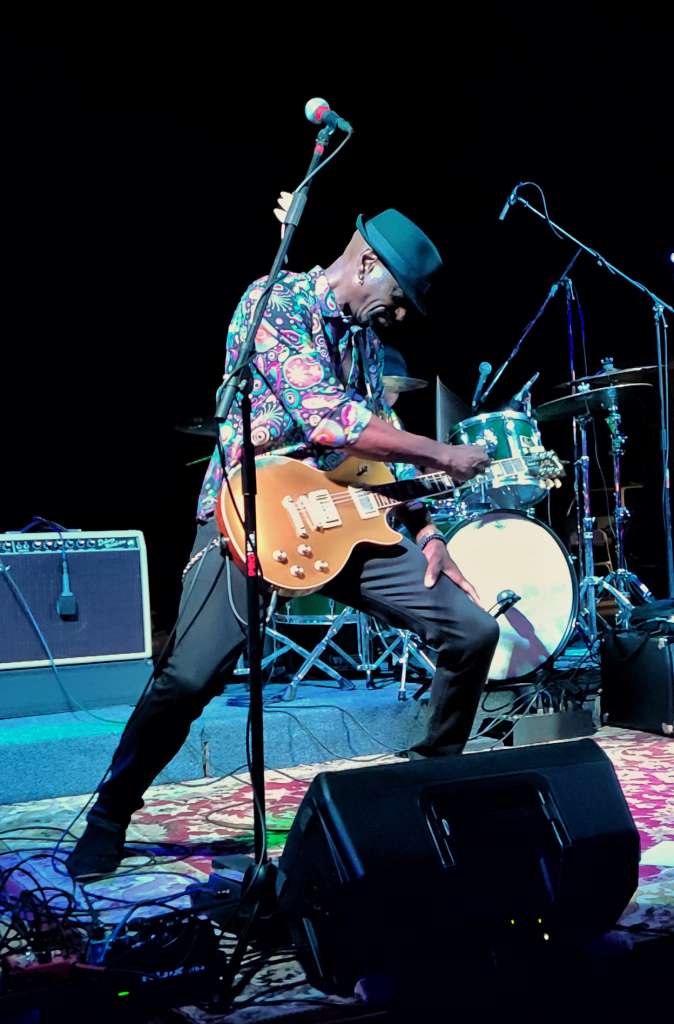
Were you playing at the time and did living overseas have an impact on your music? “Yes it did. I was 18 and was performing in a band in the States. So, I formed a band with a few GI’s and we did a few originals, but mainly popular covers of the time. We played in Hohndorf, a local town about 4 kilometers from the base. The German people loved us. We played there as much as possible. Living in Europe opened my eyes to different cultures, food and music. It was a great education for a young man trying to escape the boredom of country living. From 18 to 21, it definitely shaped my life forever.”
Was there a family history of military service? “My Uncle, Richard Jones was in Vietnam. We were pen pals. I still have a few letters that he sent me.”
Do you have any favorite memories from your military time? “I was one of only a few privates that owned a car. I would leave base at 5pm every day and either go to Nuremberg or Furth and be back on base in the morning before 5am role call. Music, girls, nightclubs and parties! That’s what I did when I was 18. I was a bit of an outcast. A lot of things were black and white but because of the music and where I grew up, I blurred the lines. Caught a lot of flak from both sides but I was cocky, confident and didn’t care. I got tired after about a year but I’d signed up for it, so I was determined to make the best of it and I did.”
Ed Croft – United States Navy
Singer, Songwriter, Producer and Sax man, Ed Croft did Navy time in the late 80s enlisting as a Cryptologic Technician Interpretive (CTI) “I took the Defense Language Aptitude Battery DLAB test, passed and enlisted for 5 years with a sign on bonus. Only later did I learn what a CTI actually does, which was not what I was told…however, fate was on my side in boot camp. They had a recruit band, and I was selected to be the Drum Major based on my music background. I had played professionally prior to my enlistment. The Chief Musician asked why I didn’t enlist as a musician. I explained my recruiter said I needed a college degree to be in the Navy Music Program…which also wasn’t true, so he immediately got me an audition. I was selected, dropped my CTI rank and bonus, and became a Navy Musician.”
Where were you assigned? “After my music ‘A’ school in Norfolk, VA, I was asked for my top 3 duty stations. Of course, I wanted to go abroad so I picked Japan, Italy and Guam. I joined the Navy to see something else. The Master Chief asked how does New Orleans sound. I said perfect, so my next 3 1/2 years were spent in the fabulous city of New Orleans with the Navy Band of the South.”
Do you think your military experience had an impact on your music? “Absolutely! You have to be able to play, read and write all styles of music from Military marches, Classical, Jazz, Rock, Country, Pop etc. Being able to adapt and play extremely diverse styles of music has carried me all these years later. It also taught me I had the discipline and focus to play music. After my 4 years were up, this still continues to this day.”
Was there a Croft family history of service? “I come from a big military family on both my father and mother’s side of the families. My Grandfather Croft served in the Navy in WWI and WWII, and my Grandfather Peters served in the US Marines in WWII and was in the first landing troops at Guadalcanal. Then my dad and stepfather served, along with many of my uncles and cousins.”
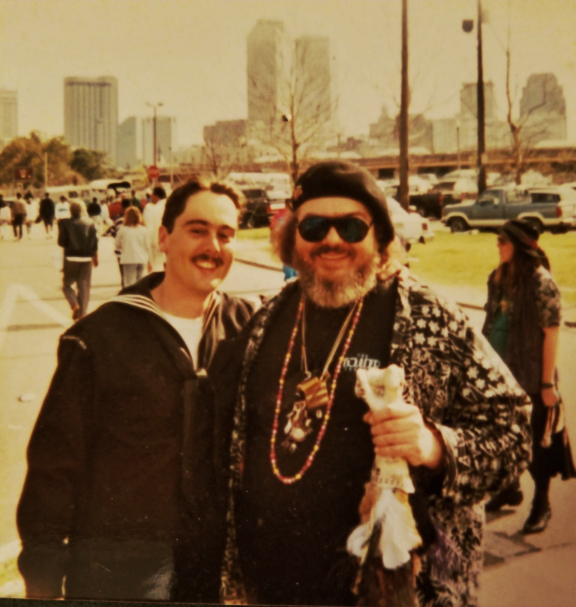
Last call, any favorite memories? “My favorite memory was my very last Mardi Gras Parade in 1991 riding in the Zulu Parade. BB King was The Grandmaster and at the end of the parade route I ran into Dr. John. I had a bit of a fan boy moment, but he agreed to take a picture with me, which I still have.”
Caron Sugaray Rayford – United States Marine Corps
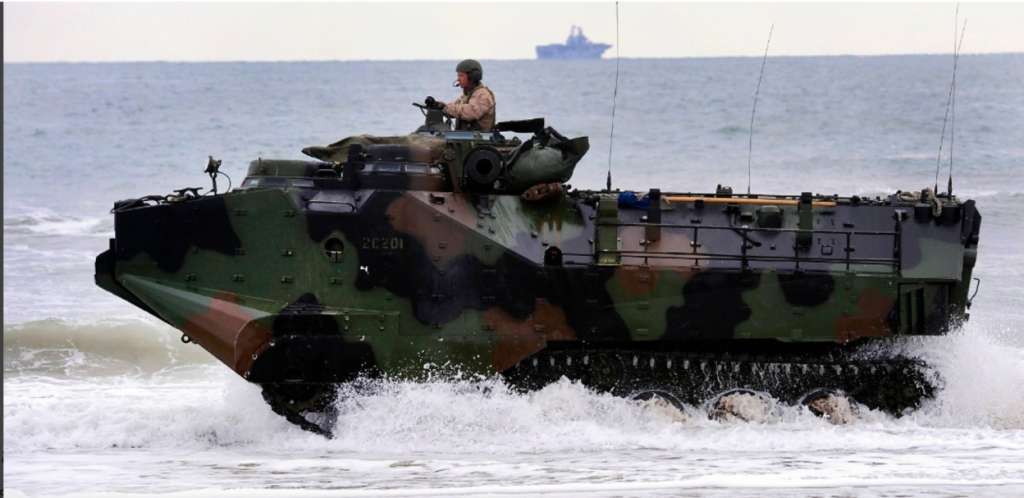
Sugaray Rayford is a Grammy-nominated and multiple Blues Music Award winning musician and he told me, “I was E-6 Staff Sergeant 2141 Amphibious Assault Mechanic. I was with the Amphibious Assault Force (AMTRACS!) I had deployments to Okinawa (during Desert Shield) and a few other places, but always back to Camp Pendleton. Good tours? “I would say I actually enjoyed Okinawa.”
Did your family have a history of military service? “Yes, I have several great Uncles, Uncles, my brother and I, we all served.” Any takeaways from your time in uniform/lessons learned? “Yes, the discipline to be on time and where I’m supposed to be…most of the ‘lessons’ were from my Grandma, but the Corps taught me to be a man.” Did you write or play music when you were on active duty? “No! The funny thing is, I didn’t sing or play for over 13 years.” You certainly seem to be making up for lost time now. Your working on I think, your 7th album and your songwriting reflects some of the toughest social issues in our world today. Tell us about the track “Invisible Soldier’ from your album, ‘In Too Deep.’ “I hadn’t really spoken about any of the military stuff, or PTSD in my other albums, but you get to a certain age and I’m not sure what that age is; but when you get to a certain age you get a real bad case of I don’t give a damn what people think. Don’t ask me if you don’t really want to know. So I’m at that age. I feel comfortable now, where I am musically and who I am…to talk about it. And I’ve talked to a lot of other Vets, and they’ve all told me, ‘talk about it, it’s cool because it might help somebody else.’ And I’ve always like putting things to music. When it’s hard to speak about a difficult issue, I wrap them in a real nice, funky tune. When you’re tapping your feet and listening to the music…but if you listen to the lyrics and hear what I’m actually singing about you’ll maybe think a little about our Vets.”
Any memorable experiences you could share from your military days? “I’m not sure if your audience is old enough to hear some of those stories, but I will share this one. I remember doing my first fuel excursion (AMTRAC) here in California. I think we were near Camp Pendleton and I was sleeping on top of my AMTRAC vehicle and I thought someone started it up, but it wasn’t being started…It was my first earthquake!”
Tony Tomlinson – United States Navy
Tony Tomlinson is a long time Southern California guitarist and bassist who currently fronts ‘TA Tomlinson & Co’ and for more than 20 years has performed with the award-winning San Diego band ‘the Fremonts.’His music career definitely has military roots. “My enlisted service not only shaped my musical journey, it enabled it.” Tony says. “I was enlisted in the Navy from 1989 – 1992. As soon as I signed the dotted line, I decided I would buy a guitar when I got to my first duty station. In January of 1990, I got orders to NSGA Naples, Italy. Right around that time, I was listening to a lot of Texas blues in the form of T-Bone Walker, the Fabulous Thunderbirds, and Stevie Ray Vaughan. In August of that year, Stevie died so I went down to the exchange and bought a black Fender Stratocaster and a small solid state amp.
My first paid gig was at the Enlisted Club in Naples. It was with a pickup band consisting of the sailors and marines stationed in Naples. I don’t remember much from that gig other than there were quite a few people there and we played ‘Smokestack Lightning’ at least three times!
A few years later, I was stationed in Misawa, Japan and played some great gigs and met some terrific musicians. One of our first gigs in Misawa was opening for Eddie Money. I also had a weekly gig with a friend and great guitar player/songwriter named Len DiGiovanna. We played at this cool British Pub for beef stew, tips, and free drinks. It was great. The Navy deposited me back in San Diego in 1995. Soon thereafter, I met Tomcat Courtney and my real relationship with the Blues began in earnest. The late 1990s were a great time to be in Southern California. On any given night, you could catch James Harman and Those Dangerous Gentlemens, Johnny Dyer, Billy Bacon, Anson Funderburgh and the Rockets, Billy Watson and his amazing lineups, Big Sandy and his Fly-Right Boys, the Paladins, and many great local bands.”
What was your job on active duty and any memorable tours? “I was a CTO3 (crypto logic technician operator) when I got out. Right before I got out, I had begun the process of converting to intelligence specialist and did a brief stint in the Reserves. But my most memorable tour was onboard the USS Austin (LPD-4) in support of Desert Shield/Storm. Due to the nature of my work, I was able to pick up some great radio stations out of France that broadcast wonderful blues programming.”
Was there a Tomlinson family history in the military? “My grandfathers and great uncles were in WWII, my Dad was in the Navy, and my uncles served in the Army in Vietnam.”
I know you recently retired after 30 plus years of combined service with the Navy, any lasting rewards? “The Navy gave me structure and taught me professionalism; and enabled me to buy more guitars, amps…”
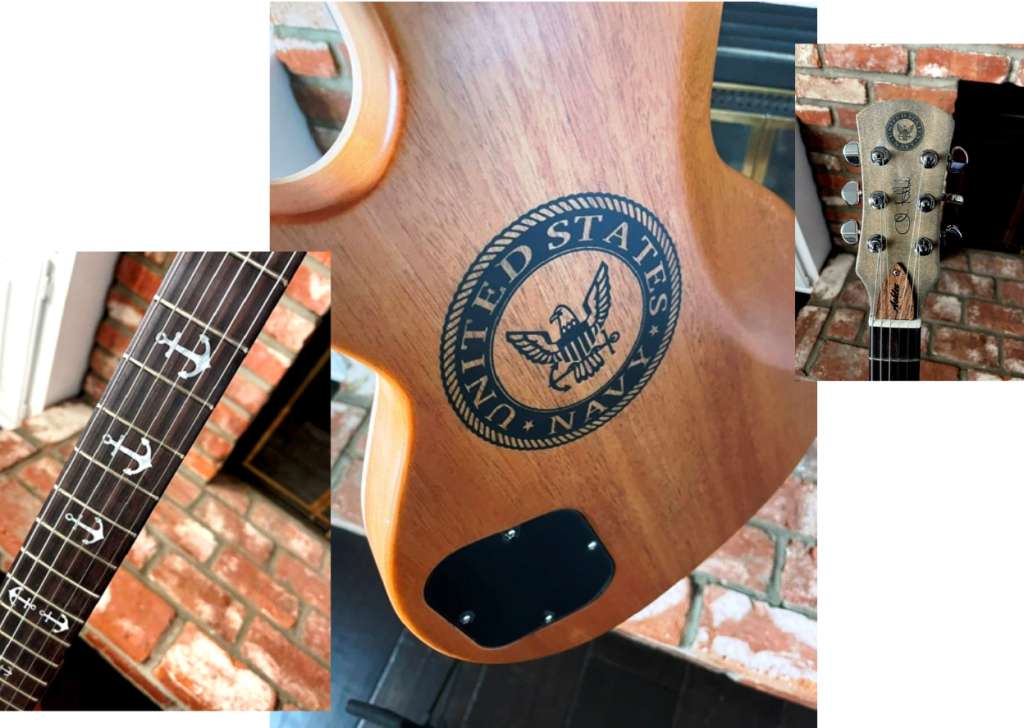
As these memories convey, everyone’s life experiences are unique to the individual, including time spent in uniform. In blues parlance – The Key to the Highway apparently is based on how you choose to navigate the terrain. For the musicians who graciously shared their journeys on this Veterans Day, the common thread seems to center on both service and giving back. Not only of their memories and the miles they’ve endured, but through the artistry and music they continue to share with all of us. Truly, they are the gifts that keep on giving. So, do me a favor…if you know a veteran or just see someone in uniform, be sure to look them in the eye, shake their hand and really mean it when you say, ‘Thank You for your Service.’