Jane Fonda and Joan Baez lead a free speech demonstration in Washington, D.C., recollecting the abuses of the McCarthy era.
Story and photo by Ed Rampell, a Los Angeles-based film historian and critic.
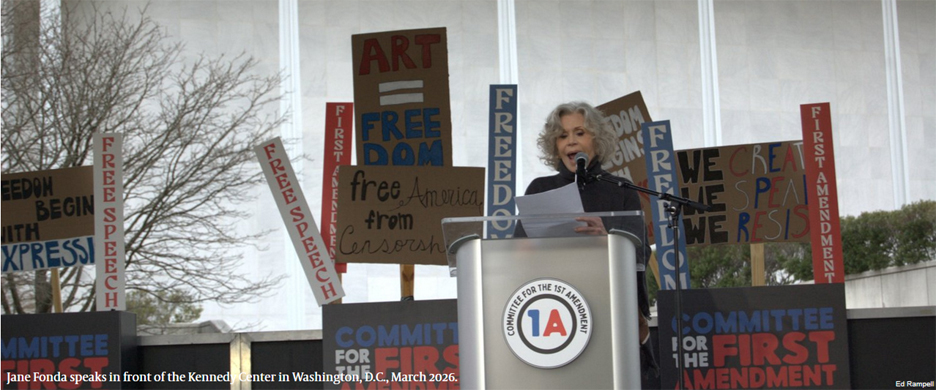
The recently revived Committee for the First Amendment, begun in 1947, during the era of anti-communist hearings in the U.S. House of Representatives and Senate, took the struggle against censorship to the belly of the beast, Washington, D.C. There, original committee member Henry Fonda’s daughter Jane Fonda, along with folksinger Joan Baez, singer and actor Billy Porter, and other free speech champions took to the streets in protest.
They raised their voices to draw attention to and resist the Trump Administration’s increasingly authoritarian efforts to censor the arts, news reporters, and media organizations, epitomized by the takeover of the nearby Kennedy Center, recently renamed the Donald J. Trump and John F. Kennedy Center for the Performing Arts. They did so by harkening back to another dark time in U.S. history, eighty years ago—the purges and persecutions of the McCarthy era.
The March 27 demonstration, which took place on a drizzly afternoon just prior to the “No Kings” Day mobilizations in the nation’s capital and elsewhere around the country, drew members of the press with television cameras perched on risers. Other journalists and supporters—all of whom had to first pass through security screening—sat on about 150 folding chairs in a gated area, facing a specially constructed stage in front of the Kennedy Center that was festooned with pro-freedom-of-speech signs and next to the Watergate Complex.
One attendee, Miles Taylor, said he came because he was “a big fan of what Jane Fonda has done with the Committee for the First Amendment, resurrecting a free speech organization from the McCarthy era for a moment that is arguably vastly more dangerous for democracy.” Taylor, a former Department of Homeland Security official, is embroiled in his own free speech battle, as he told The Progressive: “Trump accused me of treason and opened up a federal investigation” because of an anonymously written 2018 op-ed in The New York Times critical of the first Trump Administration.
The original Committee for the First Amendment actually predated the rise of Wisconsin Republican Senator Joseph McCarthy’s anticommunist witch hunt, which began in 1950.
“The Committee for the First Amendment is a recreated organization that was first formed in 1947 by Hollywood actors and directors rallying in support of a group called the Hollywood Ten,” James Lardner told The Progressive at the protest. His father, screenwriter Ring Lardner Jr., was summoned before the House Un-American Activities Committee (HUAC), along with others, “to testify about their political beliefs and associations.”
Asked by the Congressional inquisitors if he was a member of the Communist Party, Ring Lardner Jr. famously quipped: “I could answer the question the way you want . . . but if I did, I would hate myself in the morning.” Lardner, who had won an Academy Award for co-writing the 1942 Katharine Hepburn-Spencer Tracy comedy Woman of the Year, was imprisoned and fined for contempt of Congress along with the other members of the Hollywood Ten.
His son James, who is involved in the climate action group Third Act and distributed No Kings Day leaflets at the event, believes threats to free speech today are “worse [than in the times of the Hollywood blacklist]. We are spiraling towards dictatorship, a white nationalist police state, to a degree that wasn’t true in the late 1940s.”
From 1947-1960, the Hollywood Ten and about 300 other Hollywood talents who refused to provide to HUAC the names of others accused of leftwing politics, were labeled as “un-American” and blacklisted from working in the film and television industry. But none of them were ever charged with espionage or sabotage: Their real “crime” was publicly expressing viewpoints disapproved of by the U.S. government.
At 2:00 p.m. on Friday, March 27, Crys Matthews kicked off the program, saying, “I’m Black, a woman, lesbian, and a folksinger,” after which she sang her 2025 anthem “Sleeves Up.”. Next, activist and actor Jane Fonda took the stage, explaining why she was reestablishing the committee which her father had been an original member of in 1947, together with other movie stars such as Fredric March, Humphrey Bogart, Lauren Bacall, and Judy Garland.
“The attacks from the government are far more comprehensive today,” Fonda told the gathering. “Books are being banned, plaques and monuments depicting historical events this administration wants to forget are being removed [from] museums, the National Endowment of the Arts [and] state arts councils” are under attack, contends Fonda, who decried Trump’s seizing control of the Kennedy Center, where “fifty more people were fired just today. Some of them are with us [at this event].”
The two-time Oscar winner went on to condemn media mergers that the Trump Administration has been approving, while “he goes after artists. We can model courage, and courage is contagious . . . . The general public may think all this doesn’t affect them, but it does. If we don’t fight back, the news will be increasingly fake, and we won’t be allowed to know what’s happening. Our children’s academic curriculum will be actually censored and ticket costs for cultural events will go up while the quality will go down.”
Fonda proclaimed that “the bedrock of our democracy is the First Amendment,” which, she noted, “suffers greatly in times of war” as the government “works to crush internal dissent.” Fonda should know: She was surveilled by the FBI and persecuted for her outspoken opposition to the war in Vietnam, where she intrepidly traveled as U.S. bombs dropped. She was pejoratively nicknamed “Hanoi Jane” because of her relentless advocacy of peace with the Vietnamese people.
Novelist Ann Patchett spoke next, warning that “Book burning is a terrible thing; 300 books have been pulled from bookshelves. It’s not just Lady Chatterley’s Lover, it’s Toni Morrison’s Beloved.” She was followed by former MSNBC and CNN hosts Joy Reid and Jim Acosta, both of whom spoke out against news censorship, denouncing the arrests and court cases against Don Lemon and Georgia Fort. Reid, who is a woman and Black (two populations unable to vote for much of our nation’s existence), defended the First Amendment, saying: “You can fault the framers [of the Constitution] without faulting the frame.”
A highlight of the afternoon’s program was a reenactment of the June 12, 1956, HUAC hearing of Black activist, actor, and singer Paul Robeson, portrayed by Billy Porter. Robeson delivered what is probably the most defiant testimony in the annals of the blacklist, which the performers reenacted using the actual HUAC transcripts.
“The reason that I am here today . . . from the mouth of the State Department itself, is: I should not be allowed to travel because I have struggled for years for the independence of the colonial peoples of Africa . . . . The other reason that I am here today, again from the State Department . . . is that when I am abroad I speak out against the injustices against the Negro people of this land . . . . I am being tried for fighting for the rights of my people, who are still second-class citizens in this United States of America.”
Grammy-nominated singer-songwriter Maggie Rogers then performed, followed by legendary activist and musician Joan Baez, who sang Bob Dylan’s classic “The Times They Are A-Changin’ ” and the Civil Rights Movement freedom song, “Ain’t Gonna Let Anybody Turn Me ’Round.”
Other speakers and performers included poet and author Rupi Kaur; Emmy-nominated writer and author Bess Kalb; Katie Bethell, executive director of MoveOn and a No Kings organizer; Jessica J. González, co-CEO of the media reform group Free Press; and Logan Keith, national communications coordinator of the 50501 movement and an organizer with No Kings.
Finally, the crowd heard from Kristy Lee, a self-described “gay, legally married folksinger from the South” who pulled out from a scheduled performance at the Kennedy Center over concerns about Trump’s “political branding” of events there. “Playing there would have cost me my integrity, which is worth more than a paycheck,” she explained. Lee called Fonda, Baez, and all of the other performers and speakers to join her onstage for a rousing rendition of her song “Free Love.”
The Los Angeles-based Fonda, still spry at age eighty-eight, later announced that she was leaving to attend the flagship No Kings rally in Minnesota. It was a moment that reminded this film historian of her father’s speech at the end of 1940’s film The Grapes of Wrath, when, during the depths of the Great Depression, Henry Fonda’s character Tom Joad leaves his family to join the struggle to unionize farmworkers, explaining: “I’ll be all around in the dark—I’ll be everywhere. Wherever you can look—wherever there’s a fight, so hungry people can eat, I’ll be there. Wherever there’s a cop beatin’ up a guy, I’ll be there.”


















Rodrigo
May 5, 2026 at 5:25 pm
I hate to burst your bubble but that event was laughable. Not only did the aging “stars” have trouble reading their lines but they couldn’t even expound on their anti-Trump narratives without a teleprompter.
What happened to their “No Kings!” rally when a real King (Charles) came to town? They applauded the monarchy that oppresses their own people. What a joke!
And who really cares what these celebrities think anyway? Their on screen persona defies their real life idiocy. Just look at their track record for failed marriages and destructive children.