By Ringo Boitano with assistance from the National Paralympic Heritage Trust & European Association of Neurosurgical Societies
Professor Sir Ludwig is renowned as the father of the Paralympic movement. He was the medical pioneer who proved that disabled sport could be as competitive and exciting as a non-disabled sport. In September 1943, he took charge of the National Spinal Injuries Unit at Stoke Mandeville in England. He implemented his own theories on how best to treat patients who had paraplegia by introducing rehabilitation through sport. This led to national competitions, then to the International Stoke Mandeville Games and finally the Paralympic Games, which has become the third largest sporting event in the world.
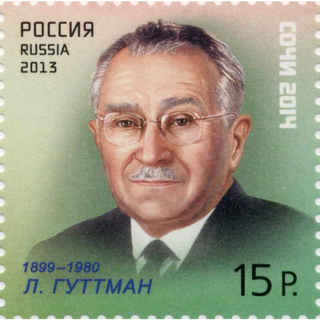
Courtesy of Psychology Today New Zealand
The Beginning
Born in Germany in 1899, then later volunteering at an accident hospital in Königshütte in 1917, he encountered his first paraplegic patient, a coal miner with a spinal fracture.
By 1933, Guttmann was working in Breslau (now Worclaw, Poland) as a neurosurgeon and lecturing at the university. Guttmann was expelled from his university appointment and his job in 1933 under the Nuremberg Laws, and his title was changed to Krankenbehandler (one who treats the sick). With the arrival of the Nazis in power, Jews were banned from practicing medicine professionally; Guttmann was assigned to work at the Breslau Jewish Hospital, where he became medical director in 1937. Following the violent attacks on Jewish people and properties during Kristallnacht (The Night of Broken Glass) in November 1938, Guttmann ordered his staff to admit any patients without question. The following day, he justified his decision on a case-by-case basis with the Gestapo. Out of 64 admissions, 60 patients were saved from arrest and deportation to concentration camps.
Earlier, in 1928, Guttmann was told to start a neurosurgical unit in Hamburg, but this post only lasted a year when he was instructed to return to Breslau as a first assistant. He remained in this job until 1933 when, under the Nuremberg Law, the Nazis forced all Jews to stop practicing medicine at Aryan hospitals. Under such oppression, Guttmann became neurologist to the Jewish Hospital in Breslau and was elected Medical Director of the whole hospital in 1937.
On November 9, 1938 (Kristallnacht), Guttmann gave orders that any male person entering the hospital was to be treated, despite the racial laws specifying that Jewish doctors could only treat Jewish patients. The following morning, he had to justify the large number of admissions (64 patients) to the SS and the Gestapo.
Like all Jews, Guttmann’s passport had been confiscated, and he was not allowed to travel; however, in December 1938 he was ordered to travel to Lisbon to treat a Portuguese associate of the dictator, Salazar. On his return journey he was granted permission to go to England for two days. He managed to secure a visa and emigrate to England with his wife and two children. Guttmann was already in contact with the British Society for the Protection of Science and Learning and was offered a grant.
Guttmann started his medical studies in April 1918 at the University of Breslau. He transferred to the University of Freiburg in 1919 and received his Doctorate of Medicine in 1924.
Escaping to Britain
The Guttmann family left Germany on the 14th of March 1939, and went to Oxford where the family found a small house to live in. Guttmann was working at the Radcliffe Infirmary and at St Hugh’s College Military Hospital for Head Injuries. In 1943 he was asked by the Government to become Director of the new National Spinal Injuries Centre at the Emergency Medical Services Hospital at Stoke Mandeville. He accepted the post on the condition that he could treat patients in his own way with no interference.
1944-66 The National Spinal Injuries Centre
The new Spinal Injuries Unit was opened at Stoke Mandeville Hospital in February 1944 with Dr Guttmann in charge. It had 24 beds and one patient. It was initially very poorly resourced, but the medical need was clear; within six months Guttmann had nearly 50 patients.
When Ludwig Guttmann started work at the Spinal Injuries Centre at Stoke Mandeville, the average life expectancy for paraplegics was only two years from the time of injury. Guttmann refused to accept that a spinal injury was a death sentence, and his advancements in the treatment of paraplegia revolutionized the field. He influenced and taught a whole generation of physicians from all over the world in his methods, and centers were established worldwide.
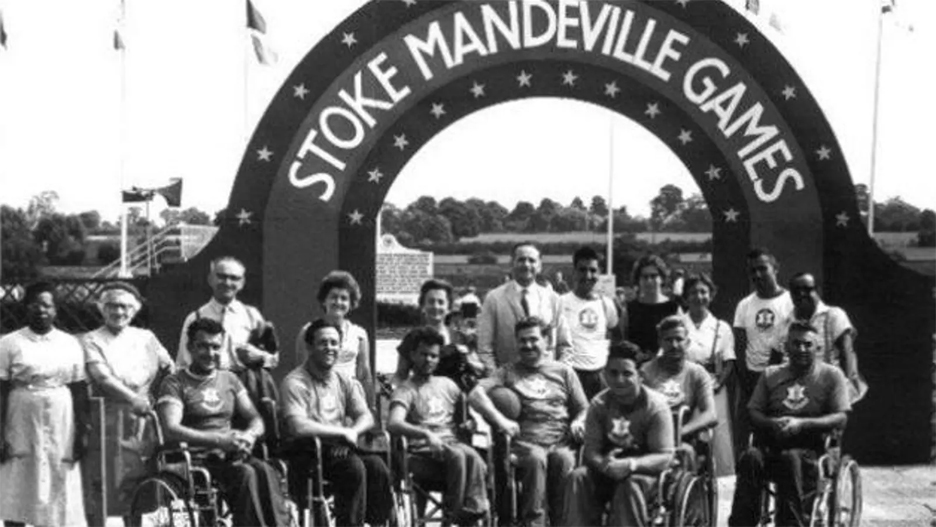
Rehabilitation
An important part of the treatment was to ensure that patients maintained one hope of making progress and returning to their previous life. Patients took part in activities to keep them active – a social rehabilitation as well as a medical one. Workshops where the patients could do woodwork and clock and watch repairing were set up in the hospital. But it was the encouragement of sporting activities that was to make the greatest impact on the wards. The first sport was wheelchair polo using walking sticks and a puck, but this was soon replaced by wheelchair basketball. Guttmann noted that in mixed basketball games between wheelchair athletes and non-wheelchair players that the wheelchair athletes would generally win, having stronger upper muscles.
Archery was also popular; it too relied on upper body strength which meant that paraplegics could compete with their non-disabled counterparts, and it was archery that was the first competitive sport at the Stoke Mandeville Games in 1948.
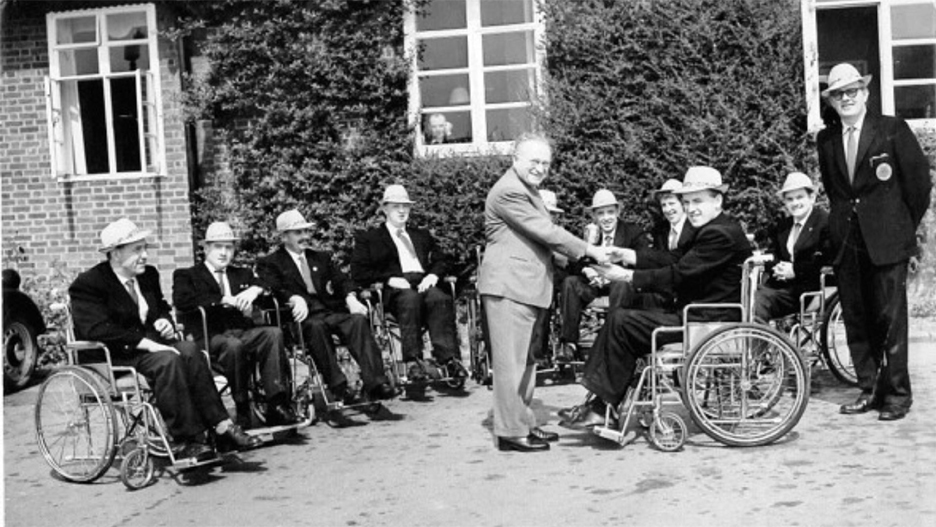
1966-80: Retired but still active
Following his retirement from the Spinal Injuries Centre in 1966, he continued to be focused with the games and the national and international organisations, both sports and medical. That year he was knighted by Her Majesty the Queen, becoming Professor Sir Ludwig Guttmann. In 1969, a new sports center was opened by Queen Elizabeth II on the Stoke Mandeville Hospital grounds, later renamed ‘Ludwig Guttmann Sports Centre for the Disabled’ after his death.
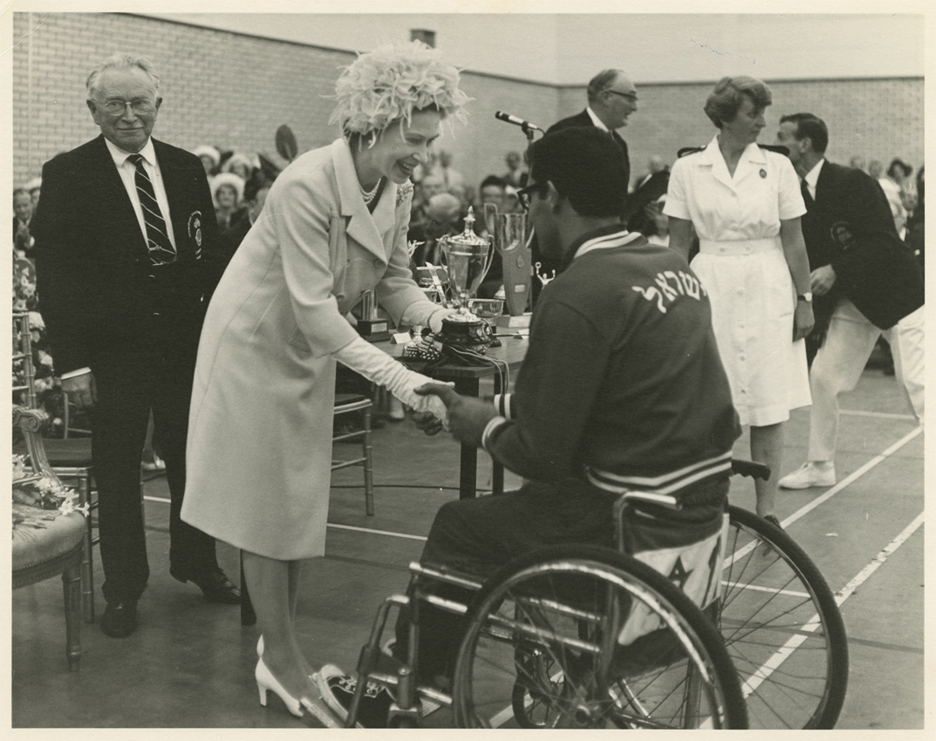
As well as his involvement with the games, he continued to travel and lecture on spinal injuries all over the world, continuing to educate and influence others with his theories and methods. However, it was his leadership of the disabled sports organizations that occupied him through the late 1960s and 1970s. It was in the 1970s that Guttmann spear-headed the conversations with the International Olympic Committee about the use of the term, and the later establishment of the International Paralympic Committee.
It was Professor Sir Ludwig Guttmann’s drive for disabled sportsmen and women to be included in the Olympics that gives us the Paralympic Games today. The London 2012 Paralympic Games showed how close the world has got to Guttmann’s vision with the Olympic Games and Paralympic Games being organised in tandem. However, there is still a way to go to see the two events combined into one sporting event where disabled athletes compete alongside their non-disabled counterparts.
Professor Sir Ludwig Guttmann died March 18, 1980 of heart failure. He did not live to see his vision realized, but his work continues through the current disabled sports organizations and through the National Spinal Injuries Centre at Stoke Mandeville, which continues to be a world leader in the treatment of spinal injuries.






















Senor Steve
February 22, 2026 at 4:32 am
Two things jump out – that the life expectancy at the time was only two years from the time of injury, and that the Paralympics is the third largest sporting event in the world. What an impact Mr. Guttman and folks like him have made!