Story and photographs by Corinna Lothar
They left in droves for the new worlds, some to North America, others to Australia and New Zealand. They were the Irish poor, fleeing from famine-ridden Ireland where only the English had enough to eat.
From 1848 to 1950, over 6 million adults and children emigrated from Ireland, more than a third departing from Cobh (pronounced “Cove”), Queenstown under British rule, in County Cork. The story of this exodus is detailed in “Cobh, The Queenstown Story,” a multi-media exhibit presented at the Cobh Heritage Center.
The Center is located in a beautifully restored Victorian railway station and offers visitors a fascinating introduction to the history of this charming small town and its harbor on the southern coast of Ireland’s County Cork.
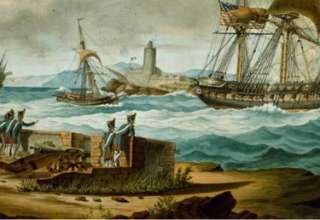
The story is told with dramatic detail and panoramas – with sound – of life aboard the ships sailing to a better life. The ships were crowded, sometimes desperately so for the poorer passengers, who often spent the passage in squalor below decks.
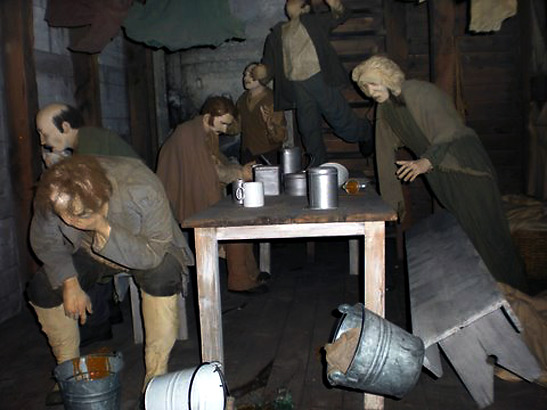
Panorama of emigrants on shipboard, Cobh Heritage Center.
Not all emigrants left because of the failure of the potato crop, which resulted in one and a half million emigrants between 1845 and 1851. While the exodus was largely the result of poverty and crop failure, other causes were the land system and poverty of opportunity.
The exhibit further tells the story of the convicts deported from Ireland under horrendous conditions akin to those of the slave ships. The first convict ship to travel directly from Ireland to Australia sailed in 1791 and carried 159 prisoners. Between 1791 and 1853, 30,000 men and 9,000 women were deported from Ireland for crimes ranging from petty theft to murder.
The Center has additional exhibits devoted to the Titanic, which called at the port of Queenstown on its fatal 1912 voyage to America, and the Lusitania, whose survivors were ferried to Queenstown after the ship was torpedoed by a German submarine in 1915 about 10 miles off the port of Kinsale.
123 passengers embarked the Titanic at Queenstown, 113 in steerage. The 151 dead from the Lusitania were buried in mass graves in the Old Church cemetery, just north of Cobh.
The Center offers a genealogical search survey for visitors interested in tracing their Irish ancestry. There are a restaurant and several shops, including the ubiquitous place to buy gifts and souvenirs.
The Great Famine exhibit in the Skibbereen Heritage Center in West Cork – located in the Old Gasworks building – offers a fascinating glimpse into the effects of the failure of the potato crop. In 1841, the population of Ireland was 8.5 million people. Nine years later, more than 1 million had starved or otherwise died in terrible conditions. Another million had emigrated.
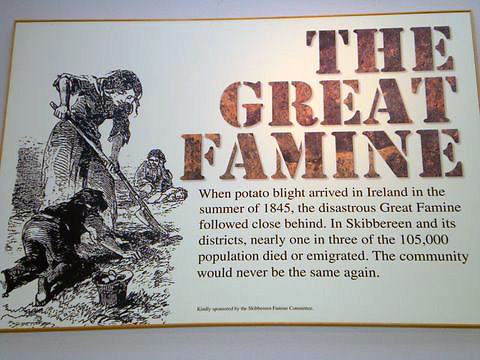
Part of Great Famine Exhibit, Skibbereen Heritage Center.
Skibbereen was one of the worst affected areas in all of Ireland. Newspaper accounts, shown in the exhibition, describe the dreadful conditions of the time. Between eight and ten thousand unidentified men, women and children are buried in the famine burial graves across the River Ilen from the Heritage Center. Throughout the exhibit, audio-visual accounts lend a graphic portrait of the times and the suffering of the Irish.
Today, Skibbereen is an attractive small town with a lively weekly market, some good restaurants and an array of shops on its “high,” or main street.
Residents of Kinsale could see the Lusitania as it sank. Kinsale, once a fishing village, has been transformed into a tourist destination, a “foodie hub” where each October a four-day gourmet festival takes place.
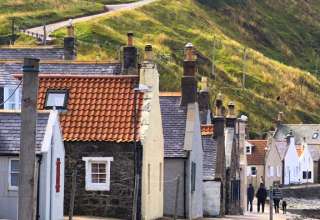
It remains a lovely small town with brightly painted houses, window boxes bursting with color on hundreds of windows, dozens of art galleries and craft shops, a regional museum housed in the old Market House (built in 1600), and a 17th century fort located at the head of the harbor. The town boasts one of the best restaurants in Ireland: if you can’t get a reservation at Fishy Fishy Café, try the Blue Haven Inn, which has a fine kitchen, old fashioned atmosphere, excellent seafood and a first class wine list.
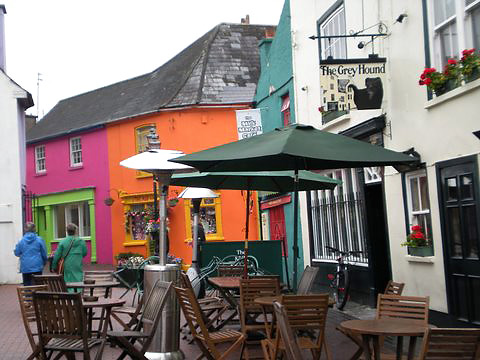
Kinsale.
Kinsale has its castle too. Desmond Castle, built around the year 1500 by the Earl of Desmond, served originally as the Kinsale Customs House. It was used by the British during the American Revolution as a prison for captured American sailors, and during the mid-18th century, it housed French prisoners. During the years of the great famine, the castle became a workhouse for starving families. Today, it’s home to the International Museum of Wine. An exhibition in the museum traces the story of Ireland’s wine links to France and the rest of the wine producing world.
There are castles scattered throughout County Cork, as elsewhere in Ireland, from those like the restored Dun na Sead castle in Baltimore now occupied by a family, to the legendary Blarney Castle.

The heart of County Cork is Cork City, the Republic of Ireland’s second city and a smaller version of Dublin. Downtown Cork City offers locals and visitors alike versions of the department stores found in Dublin. In the center of town is the marvelous English Market, a gourmet hub selling fresh produce, meats, cheeses – including hard to find Cashel blue, Ardrahan and Gubbeen – bakery goods, wines and an assortment of Irish food, such as drisheen (blood pudding), crubeen (pigs’ feet) and barmbrack (a fruit and spice bread). Upstairs in a gallery above the market, a tearoom serves sandwiches, cakes and light dishes are served. The market dates from James 1st in 1610, although the present building opened in 1788, restored in the early 1980s.
On a hill overlooking Cork City’s center, St. Anne’s Church is famous for its chiming bells and red and white color scheme created by the use of red sandstone and white limestone. Whenever a member of the McOsterich family, who were responsible for the design and erection of the bell tower, marries anywhere in the world, the bells ring out in honor of the wedding. On top of the bell tower is a weather vane in the form of a salmon representing the fish in the River Lee that flows through the city.
The tower is adorned with a four-faced clock, known by Corkonians as “the four-faced liar” because the time on each face is slightly different during the hour. Because the numbers on the faces of the clock are made of gilded wood, some of the pieces of wood are thicker than others and some hands stick as they go through the hour. But all come together on the hour.
Cork’s Butter Museum stands in a small square near St. Anne’s Church and tells the story of the Cork butter trade. Cork was once the largest butter trading market in the world, and the museum’s exhibition traces both the historic and current dairy culture in Ireland. The exhibition includes traditional and modern butter-making paraphernalia.
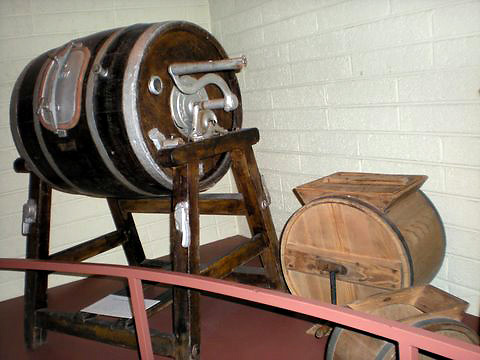
Butter churns, Cork Butter Musseum.
On the coast road, about 30 miles from Cork City, is the picturesque village of Timoleague, which hosts a lively festival each August. The ten-day festival includes live street music, pig racing, and competitions for the best costumes.
The village is dominated by the ruins of an ancient abbey, founded by the Franciscan order in 1240 A.D. The monks were dispersed by the Reformation, but returned at the beginning of the 17th century and remained until 1629. The abbey was sacked by British soldiers in 1612, but much of the architecture remains. It’s a romantic ruin perched at the edge of a sea inlet.
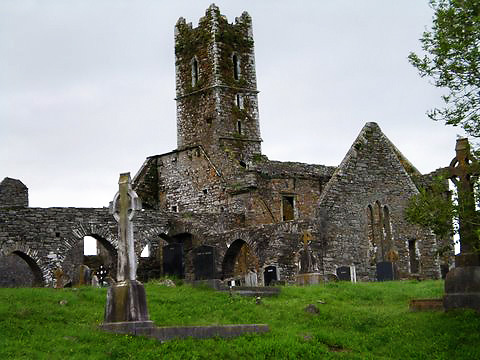
Timoleague Abbey ruins.
The verdant countryside of County Cork is typical of southern Ireland: gently rolling pastures of green, green grass, peacefully grazing cows and sheep, richly wooded hills, old stone walls, ruined castles and ancient graves, pretty villages with many a pub, startling views of the sea and remnants of the Celts of yore. Elegant manor houses, some now transformed into small hotels or restaurants, are scattered throughout.
Not far from the village of Rosscarbery, which grew up around a monastery established in the sixth century, is the Dromberg stone circle, a ring of 13 standing stones, considered the finest megalithic stone circle in County Cork. The circle dates from 153 B.C. and is located on a clearing with a beautiful view down towards the sea. West of the circle are the remnants of two huts and a cooking place.
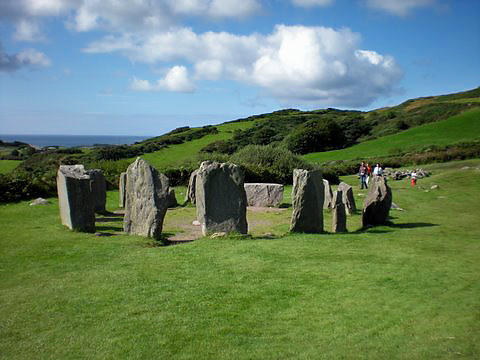
Dromberg stone circle.
Drive out to dramatic Mizen Head, the southwestern point of the Irish mainland, where the lands falls into the sea. A new suspension bridge was opened this past summer to replace the rickety old one leading across a chasm to the old signal station.
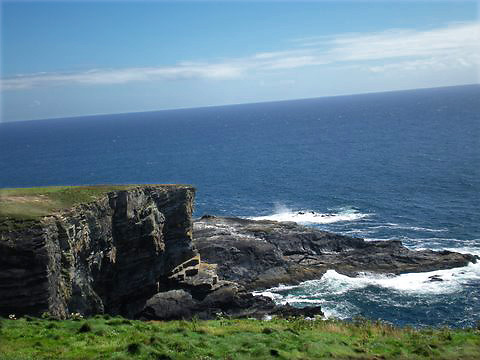
Mizen Head.
From the top of the cliff, a visitor sees the Atlantic Ocean break in roiling water and foam over the rocks. Sometimes seals, whales or dolphins come out to play in the sea. Seabirds cover the rocks in great profusion.
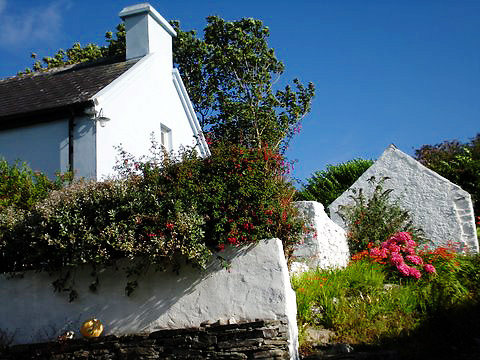
An Irish cottage by the sea.
There’s nothing but the Atlantic between Mizen Head and America, beckoning from 3,000 miles away. It’s not hard to imagine the sadness in the hearts of those emigrants from Queenstown as they glanced back at their beautiful green homeland, knowing that, in all likelihood, they would never see it again.
If You Go
Several airlines serve Dublin from the U.S. Aer Lingus is the Irish line, but I recommend Delta, which has particularly courteous and helpful personnel and serves meals across the Atlantic that are actually good enough to eat.
For information on Ireland, contact the Irish Tourist Board at www.discoverireland.com.
If you rent a car, request a small car as Irish roads are not as wide as American roads and country roads, especially unpaved ones, are very narrow. Also, remember to rent an automatic, as opposed to a manual, which requires shifting gears with your left hand.
This article was originally published in 2017.