Everyone seemed to be drinking it. A bus driver was sipping it from a gourd with a metal straw on his way to work. Retailers had large gourds on the counter, to be shared communally among the staff.
But what was it?
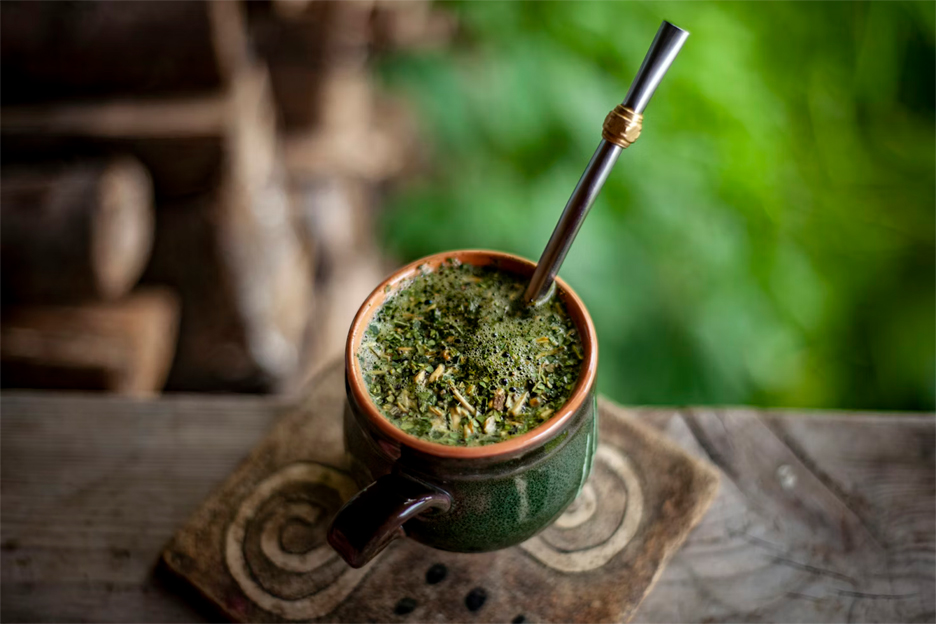
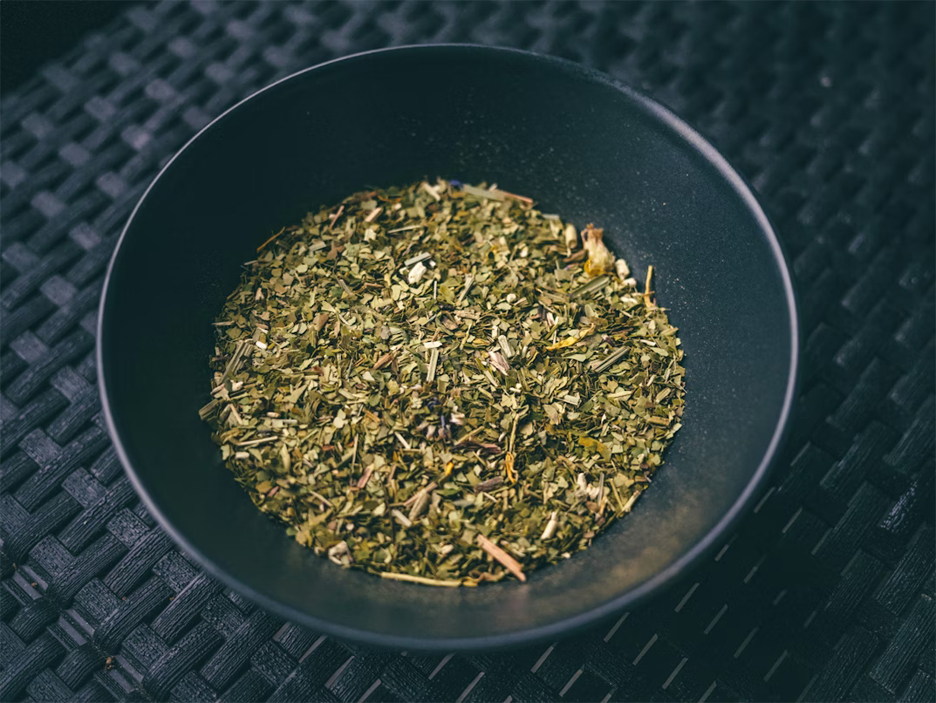
Yerba mate is a traditional South American herbal drink made from yerba leaves (paraguariensis) known for a bold, earthy, and slightly bitter taste, like green tea or tobacco. It contains caffeine, providing a smooth, sustained energy boost. Health benefits include high antioxidant levels, potential weight loss via metabolism acceleration.
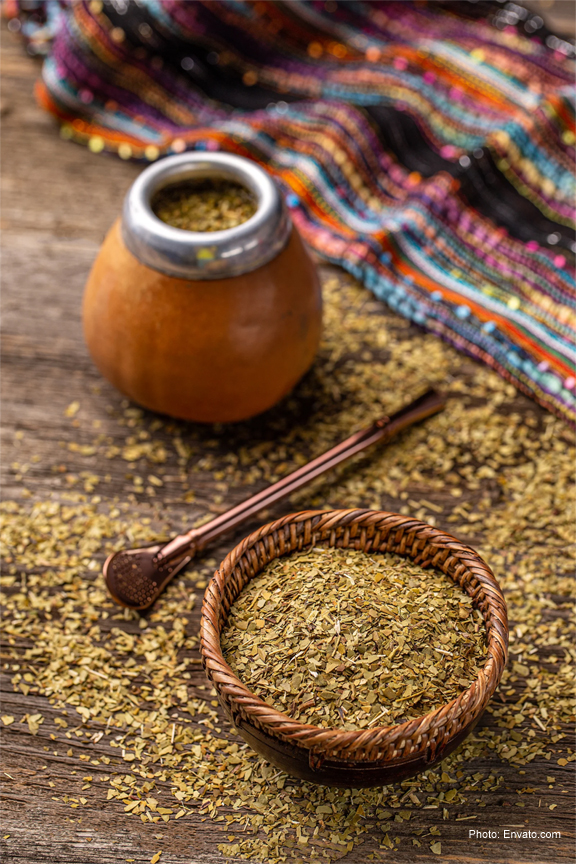
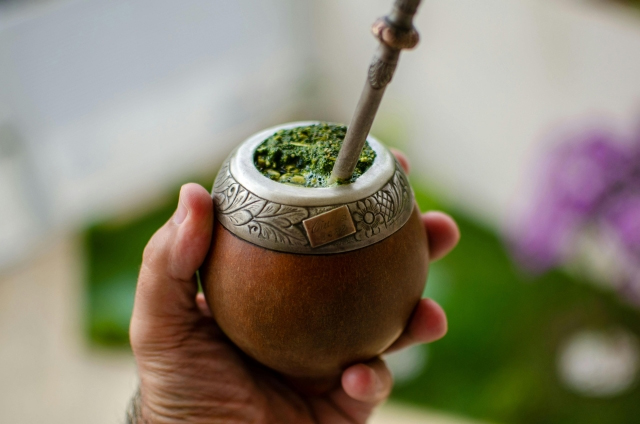
Mate (in Portuguese: matʃi]) is the traditional Argentine beverage with infused leaves, also known in Portuguese as cimarrón.. It is made by soaking dried yerba mate (Ilex paraguariensis) leaves in hot water and is generally served with a metal straw (bombilla) in a container typically made from a calabash gourd from water-resistant hardwoods such as Lapacho or Palo Santo, sometimes made from a cattle horn (guampa) in some areas. A very similar preparation, known as mate cocido, removes some of the plant material and sometimes comes in tea bags.
Mate been originally consumed by the Guaraní and Tupi peoples native to Paraguay, north-east of Argentina and South of Brazil. After European colonization, it was spread to Argentina, Paraguay, Uruguay and Chile, but it is also consumed in the South of Brazil and considered the national beverage of Argentina, Paraguay and Uruguay. Mate is also popular in Lebanon and Syria, where it was brought by immigrants from Argentina.
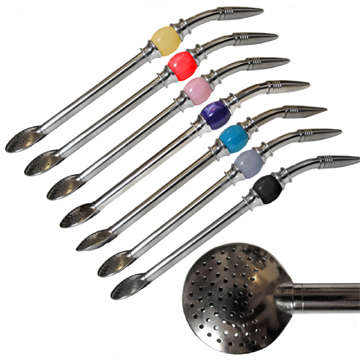
The metal straw is known as a bombilla or bomba and is traditionally made of silver. The bombilla functions both as a straw and as a sieve. The submerged end is flared, with small holes or slots that allow the brewed liquid to block the chunky yerba mate leaves that make up much of the mixture. A modern bombilla design uses a straight tube with holes or a spring sleeve to act as a sieve.
The container that mate is served is also known as mate. It is commonly made from calabash gourd but may also be made out of other materials.

History
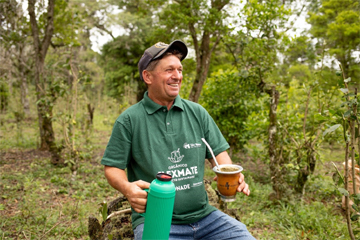
Mate was first consumed by the indigenous Guaraní People who live in what is now Argentina, Paraguay, southeastern Brazil, Bolivia, Uruguay, and the Tupí people who lived in neighboring areas. Later, it spread to parts of northeast Argentina.The scientific name of the yerba mate is Ilex paraguariensis.
Aboriginal labor was originally used to harvest wild stands of yerba mate. In the mid-17th century, Jesuits managed to domesticate the plant and establish plantations in with Indian slaves in the Argentine province of Misiones.

The English word comes from the French maté and the American-Spanish name which means both mate and the vessel for drinking it, from the Quechua word mate for the calabash gourd used to make it.
The plant was domesticated again, opening the way for plantation systems. When Brazilian entrepreneurs turned their attention to coffee in the 1930s, Argentina, which took over as the largest producer of mate, resurrecting the economy of Misiones Province, where the Jesuits had once had most of their plantations. As of 2018, Argentina was the largest producer with 56–62%, per capita as the nation’s preferred beverage.
Mates have a strong cultural significance for both national identity and society. Yerba mate is the national drink of Argentina, where drinking mate is a common social practice.
The preparation of mate is a simple process, consisting of filling a container with yerba, pouring hot, but not boiling, water over the leaves, and drinking with a straw (the bombilla) which acts as a filter to draw only the liquid and not the yerba mate leaves. Nearly all methods have some common elements. The beverage is traditionally prepared in a gourd vessel, filled with yerba and hot water, typically at 158 to 185 °F), never boiling. The drink is so popular that several electric kettle manufacturers just refer to the range on its thermostat as “mate temperature.”
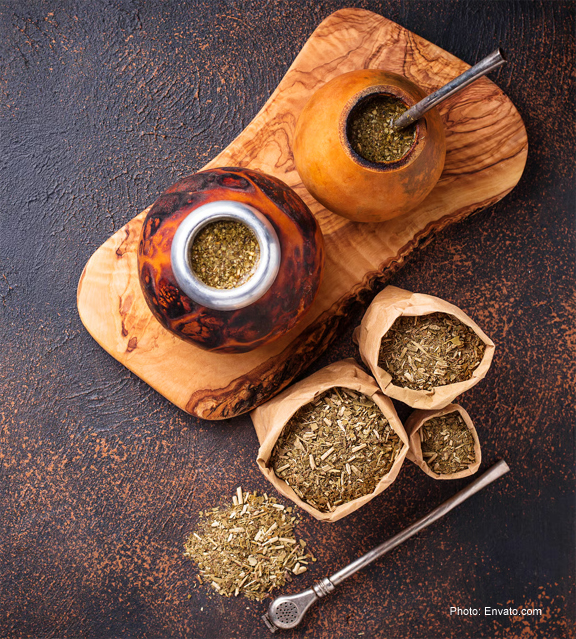
The most common preparation involves a careful arrangement of the yerba within the gourd before adding hot water. In this method, the gourd is first filled one-half to three-quarters of the way with yerba. Too much yerba will result in a “short” mate; conversely, too little yerba results in a “long” mate, both being considered undesirable. After that, any additional herbs may be added for either health or flavor benefits, a practice most common in Paraguay, where people acquire herbs from a local yuyera (herbalist) and use the mate as a base for their herbal infusions. When the gourd is adequately filled, the preparer typically grasps it with the full hand, covering and roughly sealing the opening with the palm. Then the mate is turned upside-down, and shaken vigorously, but briefly and with gradually decreasing force, in this inverted position. This causes the finest, most powdery particles of the yerba to settle toward the preparer’s palm and the top of the mate.
Once the yerba has settled, the mate is carefully brought to a near-sideways angle, with the opening tilted just slightly upward of the base. The mate is then shaken very gently with a side-to-side motion. This further settles the yerba mate inside the gourd so that the finest particles move toward the opening and the yerba is layered along one side. The largest stems and other bits create a partition between the empty space on one side of the gourd and the lopsided pile of yerba on the other.
After arranging the yerba along one side of the gourd the mate is carefully tilted back onto its base, minimizing further disturbances of the yerba where it is re-oriented to allow consumption. The angled mound of yerba should remain, with its powdery peak still flat and mostly level with the top of the gourd. A layer of stems along its slope will slide downward and accumulate in the space opposite the yerba.
This careful settling ensures that each sip contains as little particulate matter as possible, creating a smooth-running mate. The finest particles will then be as distant as possible from the filtering end of the straw. With each sip, the smaller particles would inevitably move toward the straw, but the larger particles and stems filter much of this out. A sloped arrangement provides consistent concentration and flavor with each filling of the mate.
Now the mate is ready to receive the straw. Wetting the yerba by gently pouring cool water into the empty space within the gourd until the water nearly reaches the top, then absorbed into the yerba before adding the straw, allowing the preparer to carefully then shape and pack. The straw is inserted with one’s thumb and index finger on the upper end of the gourd, at an angle roughly perpendicular to the slope of the yerba, so its filtering end journeys into the deepest part of the yerbaresting against the opposite wall of the gourd. It is important for the thumb to form a seal over the end of the straw when it is being inserted, or the air-current produced in it will draw in undesirable particulates.
After the above process, the yerba may be brewed.

Once the hot water has been added, the mate is ready for drinking, and it may be refilled many times before becoming lavado (washed out) and losing its flavor. When this occurs, the mound of yerba can be pushed from one side of the gourd to the other, allowing water to be added along its opposite side; this revives the mate for additional refilling and is called “reformar o/el mate” (reforming the mate).
As of today, mate is so popular in Argentina, that you can purchase it as kit, complete with tea, gourd and straw. In many respects, like the tango, it is very much part of Argentina’s cultural identity.