






Search: Advanced | Preference

Traveling Boy means the travel adventures of the Traveiling Boitanos
Travel adventures of Wendy Koro Boitano
Travel adventures of Allan Smith Boitano
Travel adventures of Tamara Lelie Boitano
Travel adventures of Jim Friend Boitano
Travel adventures of Deb Roskamp Boitano
Travel adventures of Terry Cassel Boitano
Travel adventures of Joel Polinsky Boitano
Travel adventures of Jeff Fried Boitano
Travel adventures of Herb Chase Boitano
Travel adventures of Ringo Boitano
Travel adventures of Raoul Pascual Boitano
Travel adventures of Timothy Mattox Boitano
Travel adventures of Eric Anderson Boitano
Travel adventures of James Thomas Boitano
Travel adventures of John Clayton Boitano
Travel adventures of Brom Wikstrom Boitano
Travel adventures of Corinna Lothar Boitano
Travel adventures of Dette Pascual Boitano
Travel adventures of Beverly Cohn Boitano
Travel adventures of Ken Walker Boitano
Travel adventures of Roger Fallihee Boitano
Travel adventures of a Boitano family friend


About Eric   write me       

Eric: Europe's Churches

Europe's Churches:
Religion's Treasures

By Nancy & Eric Anderson
Photography by Authors

eople, of course, like to look at pretty things: Charlize Theron, Brad Pitt, sunsets, waterfalls, Ferrari automobiles, cathedrals. The last two might have something in common. The late French critic, Roland Barthes once said such exotic cars were the equivalent of today's great Gothic cathedrals. Maybe so and the majestic churches of Medieval Europe are on many persons' must-see lists when they head what for them is the Old Country.
There are plenty to see: Cologne Cathedral in Germany; York Minster and Canterbury Cathedral in England; and Chartres and Notre Dame in France, merely to look at those three countries. It is poignant to consider the back-breaking work that went into those masterpieces - and how long it took. Notre Dame, more than 700 years old, the most visited tourist attraction in France - more popular than the Eiffel tower - had its foundation stone laid in 1163 and was barely completed in 1250.

Remember the tale of the tourists passing a yard where stone masons' tools screamed as they toiled. "What are you doing?" one visitor shouted to a worker above the din.

"I'm cutting blocks of granite," he answered. They moved on. They approached another worker. "What are you doing?" the visitor asked again.

The worker straightened up, wiped his brow and replied, "I'm building a cathedral."

The workers who built the great churches of Europe would essentially never see the completed work. But they have left the splendor of their labor for the following world to enjoy. How architects and historians must think, Oh, if only those walls could talk! Fortunately if there's one thing the faithful do, they document the lives of their churches. There's more than a pretty face to the churches of Europe. There are their stories.

Austria

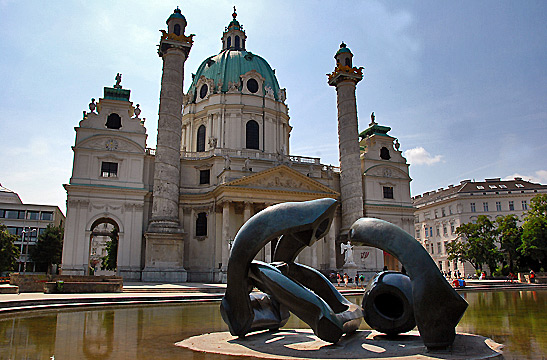
Some of the lesser known European churches get little press today. The Church of St. Charles in Vienna, for example. Built in 1727 by Fischer von Erlach in a city square redesigned by the 20th century sculptor Henry Moore, the massive church with its 236 foot-high dome has been called "the biggest Baroque church north of the Alps." But it has also been described by Vassar's Frances Daly Fergusson as "among the most widely discussed and disparaged monuments of eighteenth century Europe ... the none-too-inspired dead end of the Baroque."

the Church of St. Charles in Vienna

Critics have called it a mishmash of styles from its Greek Corinthian columns at the portico to the Roman columns like Trajan's, with the Viennese Baroque touches on the green coppered dome -- but apparently the Emperor Charles VI was under pressure to keep his promise to the Almighty in 1713. He had, after all, promised to have it built as tribute if God brought the Black Plague to a halt in his city. It was presumably important to show the people that emperors, like today's politicians, talked to God. We like it. The church not our politicians. The church is impressive and maybe cathedrals should be!

Switzerland

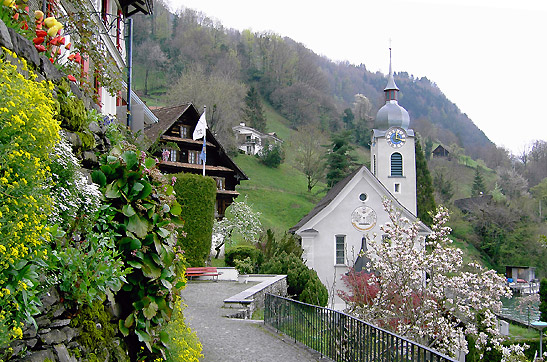
The simple but incomparably beautiful parish church of St. Idda in the Disney-like hamlet of Bauen in Switzerland overlooks the Lake of Uri. Until 1956 his fascinating village of less than 200 inhabitants could be accessed only by boat through the Lake of the Four Forest Cantons -- or if by land over steep "ferocious" mountain trails.

the parish church of St. Idda in Bauen, Switzerland

The village is now easily visited on the Swiss Tourism route to Burglen, a town of about 4,000 in the same canton of Uri, the supposed home town of William Tell. Burglen has the expected statue and a museum to his legend -- even though historians find proof of his existence hard to find.

France

Sète, a former Roman settlement, is now the largest fishing port on the Mediterranean. Its 40,000 Italian and French inhabitants stage an annual water tournament every August when sailors compete, jousting in the main canal from gigantic rowboats. The winner's name has been engraved since 1666 on a shield in the town's Paul Valéry museum.

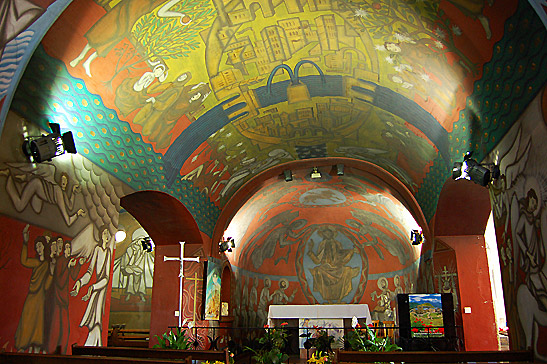
frescoes inside the Notre-Dame La Salette chapel, Sete, France

The upper part of Sète climbs up Mont St Clair. Those prepared to tackle the 500 steps to the top find there a memorable little chapel Notre-Dame La Salette. The chapel was converted from a ruined fort destroyed by Cardinal Richelieu in 1632. Entering this chapel is like stepping into the Middle Ages even though the frescoes were painted last century by the artist Jean-Claude Bringuier. Both the little Swiss parish church at Bauen and this modest chapel in Sète that receives a pilgrimage of fisherman's wives every year seem perfect for private prayer and meditation. Neither bears the trappings, the excesses of organized religion.

Russia

If religious institutions sometimes intimidate, what can be said about the Eastern European Orthodox churches that believe, in design and décor, More is Better? Russia, for example, with the arrival of communism went the other way. Magnificent churches were turned into ice-skating rinks, gas stations, even prisons. One was converted to an atheist museum! The Orthodox Church has undergone a complete renaissance now; churches have been rebuilt, restored and re-painted inside and out. Although some look like gingerbread houses many are so beautiful they make visitors catch their breaths. We have two favorites: one in each of Russia's two best known cities.

Moscow

Maybe all roads do lead to Rome but in Russia the steps taken by tourists bring them to Red Square. It's a bit spooky to stand there. As in every country with a history bad things have happened there, things that might have scared even James Bond. So why not us? And we neither speak Russian nor understand those Cyrillic hieroglyphics. But St Basil's surely soothes the savage breast.

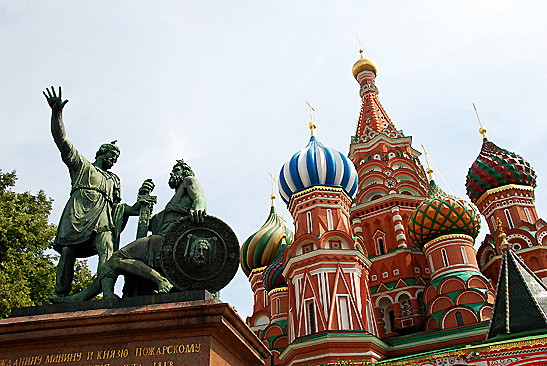
St. Basil's Cathedral, originally called the Cathedral of the Intercession of the Virgin on the Moat, was commissioned by Ivan the Terrible in the middle of the 16th century and completed in 1561 to celebrate his victory over the Mongols in 1552. In legends not unlike those surrounding the Taj Mahal in India, the architect is said to have been blinded by Ivan to prevent his creating other churches as beautiful. (Ivan was, after all, called "the Terrible.") No church could have a more elaborate and stunning exterior although the acerbic French diplomat, the Marquis de Custine, was critical of those who could "worship God in this box of confectionary work." Some diplomat! However, he uttered his remark around 1839 by which time he had changed careers and become a travel writer!

bronze statue and St. Basils's Cathedral, Moscow

The cathedral has led a checkered life and avoided destruction many times, once when Napoleon tried to blow it up on his retreat from Moscow and later when the Bolsheviks came to power. The statue beside the cathedral features two heroes from Russia's "Time of Troubles" when, after a tsar died in 1598 -- until the Romanovs came to power in 1613 -- the country was wracked in dissent and anarchy. The bronze monument was erected in the center of Red Square in 1818 but Stalin felt it impeded the Red Army when it marched on parade so he moved it to the front garden of St. Basil's in 1936.

St. Petersburg

Tsar Alexander II was assassinated in this city in 1881. A revolutionary threw a grenade that startled the tsar and when he stepped out of his carriage to deal with the radical, another assassin exploded a second bomb. The tsar fell mortally wounded on this spot where now the Church of Our Savior on Spilled Blood stands. The tsar's son, who became Alexander III, ordered the church built as tribute to his father. He required its architect, one Alfred Parland, to base the design on St. Basil's in Moscow and on the 16th and 17th century churches in the Volga town of Varoslavl. He wanted a Russian Revival style to distinguish it from the Baroque and Neo-Classical architecture that dominated his city which he felt showed its contamination by the West. The church, erected between 1883 and 1907, elaborate as it is cannot compare to the extravagant external decoration of St. Basil's. The interior is another matter.

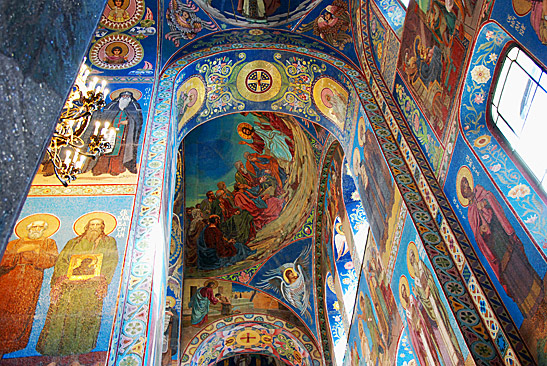
the interior of the Church of Our Savior on Spilled Blood, St. Petersburg

The area of about 80,000 square feet of mosaic tiles in the interior (as counted by most authorities) is exceeded only by the Cathedral Basilica of St. Louis in our own Missouri. The mosaics are eye-stopping. You stand surrounded by color and lost in time. It is gorgeous. Like all Russian churches that had to deal with Lenin and Stalin it has suffered. It was looted by the Bolsheviks in the 1917 revolution and turned into "a garbage dump." Later in World War II during the German siege of the city (it was called Leningrad then) which started in 1941 and lasted 900 days, two million inhabitants died of starvation and Russia's notoriously harsh winters. The building was used then as a mortuary for the corpses and subsequently as a warehouse for potatoes and ultimately for the props for opera and ballet theaters. Russia could not allow this famous church to simply disappear and for almost 30 years restoration was funded until once more the Church of Our Savior on Spilled Blood was considered ready to face its people. It has not yet been re-consecrated so remains a dazzling non-functioning church but a homage to one of the many Russian tsars who did not die in his bed.

Romania

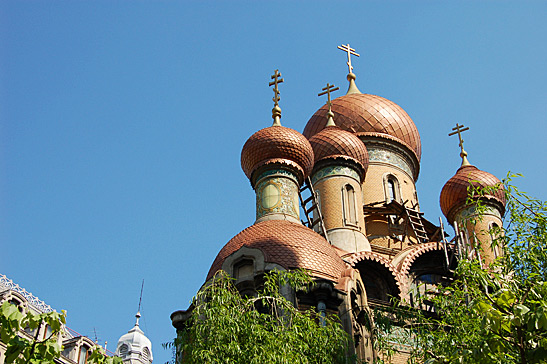
Even if you leave Russia to walk the streets of Bucharest in Romania you can't avoid churches that have suffered over the years. One, St Nicolas, even has an alternate Russian name: the Bucharest Russian Church. The church - it sits in Old Town near University Square - was built in 1909 so members of the Imperial Russian Legation would have a Russian Orthodox church for worship. It was magnificent with its gold-covered seven onion domes.

St Nicolas/the Bucharest Russian Church, Bucharest, Romania

When World War I broke out in 1914, in anticipation of Romania's invasion by the Central Powers (Germany, Austria-Hungary and Bulgaria; isn't it nice to have neighbors) everything of value in the Church was sent for safety to St. Petersburg where it was immediately looted by the Bolsheviks in their 1917 Uprising. The Russian community in town restored the church in 1921 but their priest died in 1935 and once more the church changed hands. "It later became," said our guide, "the 'Students' Church' where students from the nearby university could go to pray for favorable examination results even though, like many students, they really hadn't done any studying!"

Seems students are the same the world over.


Name: Required
E-mail: Required
City: Required
Feedback:
 

Tell Eric what you think of his article.
In the meantime, here are some of the feedback we have already received:


What a fascinating bit of Russian history you wrote about! How sad to learn that 100,000 churches were reduced to create skating rinks and such during the revolution, after seeing the photo of the interior of a magnificent church filled with art! War is so devastating on so many levels! The art of their culture is so beautiful as is shown in the image of the painted box! Thank you,

Yoka, Westlake Village, CA

Dear Yoka,

Thank you for writing. Nancy is originally Lutheran and Eric is a dour Scot, more used to the frequently cold and often cheerless churches of his native land so we were both overwhelmed to see the beauty of Russian churches. It was kind of you to write, Yoka.

Thank you,
Eric & Nancy

Interesting observations.... Very informative and thought provoking. Questions.... What would be the best way to get from Moscow Airport DME to boat dock? taxi? prearranged limo? prepaid Viking Tours transfer? Any idea on cost and travel time for taxi or limo or Viking Cruise pickup from airport to boat? We shall be flying to Moscow on our own. Do you happen to have an address for the river boat dock that Viking Cruises uses in Moscow? I would be nice to Google map the situation. Thanks,

Robert Hopwood, Ottawa, Canada

Hi Bob,

Excuse the delay; we were on a trip. I do understand your question and will try and get you an answer. The Viking river dock in Moscow was for us in the north part of the city but once we were on the boat it was an easy ten minute walk to the Metro station that had us downtown within 30 minutes. I'm a lot more relaxed at the end of a trip than at the beginning and therefore I always feel taking the cruise-line sponsored trip from the airport to the dock makes sense: What starts right usually ends right.

Eric & Nancy Anderson

Hi Bob,

I’m back with more information. The river port’s address is Northern River Boat Station Leningradsky Prospekt, Khimki. If you Google that you will see it is about 15 minutes’ walk from two Metro stations. http://www.aptouring.com.au/files/documents/17/29022_Moscow2.pdf .

I spoke to Nancy at customer relations at Viking Cruises at the new LNR Warner Center in 5700 Canoga Avenue, Woodland Hills, Calif.

She was very helpful and advises you to take the Viking transportation service. She is biased, of course, but she’s right. Moscow DME airport is 40 miles away on the opposite side of the city, at least two hours driving time. The airport has no Metro station; you’d have to take the Aeroexpress train to Paveletsky station then change to the Metro and go to Rechnoy Vokzal station then take a cab to the port. A cab all the way from DME would cost at least 2000 rubles (more than $70). That’s less than the $60 each that Viking would charge…but…I think you’d be ill-advised to do it on your own. Why start the trip where the potential to screw up is so likely? Moscow taxi drivers are as dishonest as most tourist city cab drivers and probably yours won’t speak English. I think the address in Russian is

BUT...

I strongly discourage you from economizing on this and doing it on your own. Buy the transfer and save money somewhere else.

We have other Viking Volga web articles up at http://travelingboy.com/archive-travel-eric-russia.html and at http://www.ericandersonsworld.com/story.php?id=6LvDg.

Good luck. Great show Canada’s putting on for the Olympics!

Eric & Nancy Anderson

Your blog keeps getting better and better! Your older articles are not as good as newer ones you have a lot more creativity and originality now keep it up!

Reseller Hosting, London

Hi, Is it Britni Freeman?

Thank you, we think... We suspect your comments are valid. In fact we think all of us writing for TravelingBoy are starting to get into the swing of things and do a better job -- and your encouragement spurs us to do even better. Thank you for writing. Have a good 2010,

Eric & Nancy Anderson

Dear Nancy and Eric

Thank you so much for the wonderful article on statues in Europe. Statues are my favorite art form and your descriptions were delightful to read - knowledge and fun together. I do still wonder about that foot in Rome...

Peggy - Pasadena, CA

Hi Peggy,

Thank you for writing. We appreciate your comments. We used to be critical of people who can't identify the persons on statues in foreign cities -- until one day a tourist stopped us in our own San Diego and asked us, in vain, for details on a statue we'd never noticed before! We wonder about that Roman foot too. If Eric had stood any closer he'd be in his typical foot-in-mouth position.

Eric & Nancy Anderson

I live in Santa Fe and see and delight in it every day, but your writing makes it sparkle even more. How nice to see Santa Fe through your eyes. Great photos!

Cynthia Whitney-Ward - Santa Fe, NM

Dear Dr. Anderson:

I have followed your writing career for as long as I can remember, and I think the thing I enjoy the most about your travel writing is the sense of joy and discovery that leads the reader to anticipate ever corner you turn in your travels.What a delightful traveling companion you are, and I know have always been, with that wonderfully eternally youthful joie de vivre...I wonder:do you feel that East, West, home is best? And where IS that place you have never been, but want to go most of all,yet? Bring we, your devoted readers ever along!

CAT -- San Diego (Scrips Ranch), CA

Dear CAT,

Thank for taking the time to write to TravelingBoy.com. You are very kind. We don't know that travel writers make the best companions; we suspect they may be obsessed with getting the best photograph or may monopolize the guide with questions so that others don't get to ask what interests them. What place is best? Well, it may be fun to sit in a rickshaw in Beijing or try to master the Metro in Moscow, but -- as you imply -- it is good to get home after trips.

Home is as comfortable as a pair of old shoes and home for many of us fortunately contains family.

We've never been to Easter Island and may have missed the boat (no pun intended) there. The island is losing its innocence; we've seen that happen at Machu Picchu or, closer to home, at Lake Powell in Arizona. So maybe the best travel advice is: Go when you are fit and healthy, before rising prices make a destination inaccessible -- and before hordes of tourists ruin any destination's mystique.

With best Holiday Wishes from Traveling Boy,

Eric & Nancy Anderson

* * * * *

What a fantastic primer on New York City. I think you have really captured its essence with this exciting overview of its offerings. Well done!

Gillian Abramson - New York

* * * * *

You describe a city on wheels - er, wings - and an absolutely perfect way to travel. SHOWERS & FLOWERS! Amazing! I love that your passion for all-things-aviation comes through in this story about an almost unbelievable airplane. Thanks for breaking the news in such an engaging way!

Richard Frisbie - Saugerties, New York

* * * * *

Enjoyed your blog on Romania. Noticed you called Bucharest "The Paris of the East." I wonder, is there any city not called "The Paris of something." I've read San Francisco is 'the Paris of the West,' Buenos Aires 'The Paris of South America,' and even Tromso, Norway 'The Paris of the Arctic.'

Terry Cowan - Fresno

* * * * *

Hi Terry,

Thanks for writing to TravelingBoy. And thanks for educating me; I didn't know that about Tromso, didn't even know there was a Tromso. I heard Bangkok called the Venice of the East when I was there and, in two weeks, I'm heading for the Venice of the North, St. Petersburg, Russia.

It does become a bit silly, doesn't it? But we are originally an immigrant nation that was Eurocentric. Maybe it gave our forefathers confidence even courage when they took old names, old ideas to the New World with them. I know I feel nostalgic if I drive around Ontario, Canada and see all the British place names.

I appreciate your email. Thank you for writing.

Eric

Eric -

Enjoyed your article on Madrid. I noticed that you find it superior to Rome. Most of the Spanish folks that I meet seem to prefer Barcelona. How would you rate that city?

Samuel K
Seattle

* * * * *

Hi Samuel,

We loved Barcelona although driving around the city was surprisingly complicated as our maps were inadequate. The cathedral had scaffolding around it so I couldn't get the pictures I wanted but we found the architecture fascinating and the Picasso museum rewarding. We were anxious to get on the road to Costa Brava and didn't have more than a couple of days in Barcelona.

Thanks for writing.
Eric


Great article on Madrid. I've heard there is a rivalry between the people of Madrid and Barcelona. In which city are the people friendlier? How about for hipness? I noticed you were Scottish. I felt a similar thing in Scotland, with a Glasgow v. Edinburgh vibe.

Gary
Santa Monica

* * * * *


Thank you for writing to TravelingBoy, Gary. We found Barcelona friendlier.

Maybe that's because it's not the capital and it's not so busy either. Maybe it's because the Gaudi architectural influence is pervasive and -- to both its citizens and tourists -- comforting. Maybe it's because Barcelona is the gateway to the work of artist Salvatore Dali, and his spirit catches us. (I don't know much about art but I've seen a lot of Dali's work enough to think he never took himself too seriously and often painted tongue in cheek. Maybe fun people spring for fun places?) Hipness? Madrid is more formal and dressy but Barcelona, I believe, is more hip maybe, again, because it's more fun.

Your points about Scotland are valid. It's more than a joke. The Glaswegians are more down to earth. I think we see it here in the belief that if you had a flat tire in Middle America passers-by would be more inclined to stop and help than perhaps New Englanders.

- Eric

Dear Eric,

I liked the article. As I read it, I was wondering how you as a physician were influenced by Hippocrates. What influence did this historical figure have on the practice of medicine beyond the obvious 'oath.' Why is Hippocrates considered to be such a paragon of medicine? DWA - San Pedro, CA

* * * * *


Dear David,

Thank you for writing to Travelingboy.com.

Hippocrates is revered because he believed his duty was to the individual patient, not to the community at large. This is a very important premise. The Romans, whose empire followed that of the Greeks, achieved much in health matters by emphasizing clean drinking water and personal hygiene, and created great national works like aquaducts and public baths but wealthy Romans apparently preferred Greek doctors as their personal physicians.

Hippocrates is also respected because he brought intellectual thought to diagnosis. He taught his students to use their five senses in assessing patients and was openly critical of the junk science of his day as practiced by the priest-physicians who preyed on the fear and ignorance of the ill persons who came to them.

It is true that not all medical chools today require graduating doctors to take the Hippocratic Oath but most conscientious physicians base their lifetime commitment to the practice of medicine on the life and teachings of that one man.

Or so I think. Perhaps if we knew more about our heroes they would seem less heroic. But in Hippocrates' case he did leave a record of his thoughts and some of his principles are today as strong as ever.

Thank you for writing, it is appreciated.

Eric

Stay tuned.


© TravelingBoy.com. All Rights Reserved. 2008.
This site is designed and maintained by WYNK Marketing. Send all technical issues to: support@wynkmarketing.com

Travel Ad Long

Visit Norway ad

MySwitzerland.com

Sitka, Alaska ad

Montreal tourism site

Visit Berlin ad

official website of the Netherlands

Cruise Copenhagen ad

Sun Valley ad

Philippine Department of Tourism portal

Quebec City tourism ad

AlaskaFerry ad

Zurich official website

Zuiderzee Museum ad

Like-a-Local.com

American Jazz Museum ad