






Search: Advanced | Preference

Traveling Boy means the travel adventures of the Traveiling Boitanos
Travel adventures of Wendy Koro Boitano
Travel adventures of Allan Smith Boitano
Travel adventures of Tamara Lelie Boitano
Travel adventures of Jim Friend Boitano
Travel adventures of Deb Roskamp Boitano
Travel adventures of Terry Cassel Boitano
Travel adventures of Joel Polinsky Boitano
Travel adventures of Jeff Fried Boitano
Travel adventures of Herb Chase Boitano
Travel adventures of Ringo Boitano
Travel adventures of Raoul Pascual Boitano
Travel adventures of Timothy Mattox Boitano
Travel adventures of Eric Anderson Boitano
Travel adventures of James Thomas Boitano
Travel adventures of John Clayton Boitano
Travel adventures of Brom Wikstrom Boitano
Travel adventures of Corinna Lothar Boitano
Travel adventures of Dette Pascual Boitano
Travel adventures of Beverly Cohn Boitano
Travel adventures of Ken Walker Boitano
Travel adventures of Roger Fallihee Boitano
Travel adventures of a Boitano family friend


About Eric   write me       

Eric: Europe's Statues

Europe's Statues
Story and photography by
Nancy & Eric Anderson

e Americans can be ignorant about things European, blissfully ignorant because we don't even know what we don't know about this continent, the original homeland of many Americans.
On the other hand, there has been criticism America has been too Eurocentric and, of course, many Americans have traveled in Europe or lived there for a spell in the past or even read its literature but, in general, what many Americans know about this original first world is what they've seen when Hollywood discovers a good storyline for a movie. To which some U.S. geography school teachers might say, "Thank goodness for Walt Disney!"

If we don't know Europe's history how can we understand its statues or recognize the figures standing on pedestals all over foreign cities. If those were subjects for "Jeopardy" or "Who Wants to be a Millionaire?" U.S. contestants might not make any money. You could argue how can we identify the subject of an interesting statue if the information at the base of the column is written in a Cyrillic language, for example? You mean Americans would have to learn a foreign language? Well that's another issue, another beef foreigners have about those of us who live on the other side of the Atlantic.

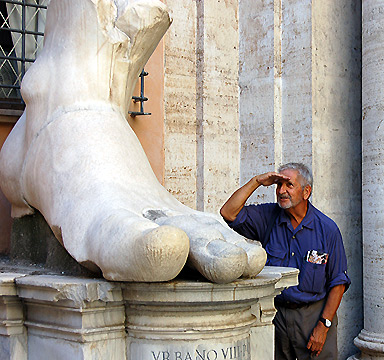
large statue of a foot in Rome

But as we, visitors, stop and gaze at interesting statues in Europe, then look for a local worthy who might know the identity of the figure we're gazing at, we sometimes get shoulders shrugged for the universal sign for "I don't know an' I don't care!" Indeed, when we asked a Roman passer by to explain why there was a large statue of a foot in his city we got a head shake and the local moved on . It's not our fault we're not learning, we think. "The fault, dear Brutus is not in our stars." Maybe the foot is a relic from some podiatry convention

A good city map and tourist guide may make the need unnecessary for a foreign language or guide. Interestingly enough old guide books may be better than recent ones if tour needs are to follow the past. If a monument was at the corner of a piazza before the first Michelin Guide came out, the best description may be in an older book because many of today's guide books try too hard to cover too much including stuff that comes and goes and is not necessarily an important part of anyone's vacation.

So what's out there among the monuments of Europe? A lot. Yesterday's princes and kings and emperors and popes must have been more pompous and narcissistic than even today's politicians. Even if we knew our foreign history it would be hard to keep up with all those emperors with unpronounceable names who stand like giants across the city squares of Europe.

Though we wonder if poet Edna St. Vincent Millay knew something when she wrote: "The rain has such a friendly sound/ To one who's six feet underground." Surely the first woman to win the Pulitzer Prize for Poetry would know.

We have some favorites.

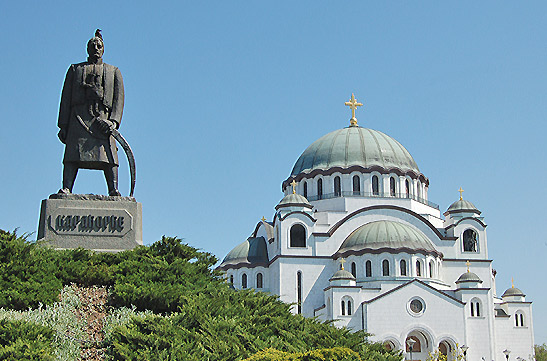
We rather like the statue of Karageorge Petrovitch in front of Saint Sava Cathedral in Belgrade for several reasons. First he has to compete and does so fairly successfully with the magnificent cathedral behind him. This church in the capital of Serbia is the largest Orthodox church in the world. It is not yet completed but when it's finished the mosaic of Jesus in the dome will be massive with each eye about 10 feet wide. We view the statue of Karadorde Petrovic sympathetically because he was also an underdog, a commoner, a cattleman who rose from humble beginnings to lead the Serbian people against the Ottoman Empire in the first part of the 19th century. He won several significant battles against the Ottomans but was finally assassinated in 1817 by a rival Serb, Prince Milos Obbrenovic who later became the wealthiest man in Serbia.

statue of Karadorde Petrovic in Belgrade

Karadorde means "Black George," a name he was given because of his violent and non aristocratic background. If the bird perched on Karadorde's head knew of his prowess with the sword it surely would take off in a hurry. The savagery and hatred between the Serbs and the Ottomans to a degree may explain -- but not justify -- the recent war in Bosnia. Such hatreds last for many generations and clarify why many Eastern European nations still detest the countries of the old Ottoman Empire; why, for example, the Greeks have no time for the Turks and why Vlad the Impaler, (the real Dracula of history) is seen as a savior of Romania, a hero because he so brutally repelled the Ottomans from his country.

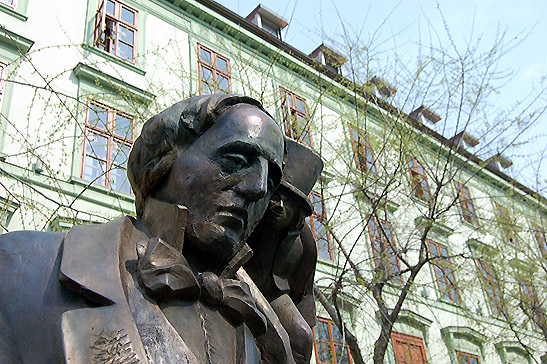
The scene is more benign in Bratislava the capital of Slovakia where a statue of Hans Christian Andersen improbably shows up on the cobbles of the Hviezdoslavovo Námestie pedestrian mall. Why here and not say Copenhagen? Well, there are plenty in Denmark and even in New York City but the statue in Bratislava -- complete with his muse on his shoulder whispering in his ear -- is indeed special., standing there because the children's author once called this place "the most beautiful city in Europe."

statue of Hans Christian Andersen in Bratislava, Slovakia

Andersen called Bratislava a "fairy tale itself." The Danish storyteller was an avid 19th century traveler. He was captivated by the city as we were, too. He wrote in his diary: "We saw … most beautiful children. I met a small girl with a big bouquet. She smiled at me, a complete stranger. Suddenly she stopped, picked one rose from her bouquet, gave it to me, bowed her head and disappeared." Hans Christian Andersen, of course, had an affinity for children that even now still comes through in his writing. The pensive mien in his statue surely contrasts with the martial ones elsewhere that seem to glorify war.

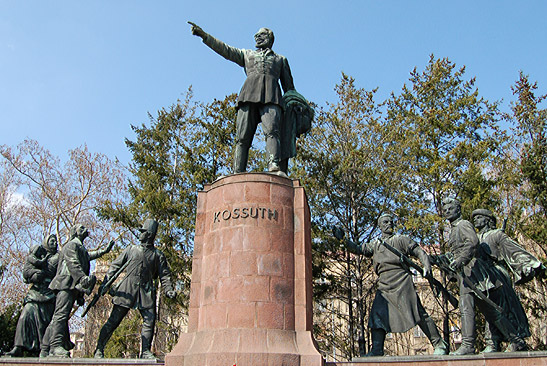
Yet there is sometimes a quiet dignity to some country's heroes such as that of Kossuth on the Heroes' Square in Budapest. The memorial stands in front of the Hungarian Parliament Building. Kossuth died in 1894, almost a half century after the 1848 Revolution he led that gave Hungary independence from Austria and the Imperial power of the Habsburgs.

statue of Kossuth, Heroes' Square, Budapest

The monument has had a complicated existence. Lajos Kossuth, the one-time Hungarian Regent-President, was a popular national hero and huge donations poured in for a memorial after his lavish funeral. After a competition, the winning sculptor János Horvay worked on the statue from 1906 until the onset of the World War I in 1914. The statue was completed in 1927 but nobody liked it. In 1950 the communist dictator of Hungary dismantled the monument on the grounds "it was too melancholic." It was given to the town of Dombovar and later reassembled in that town. In Budapest other sculptors including Zsigmond Kisfaludi Stobl created new bronze figures with the final statue showing Kossuth "pointing to a bright future" for the communist country. The posture looks awfully like that of Lenin in many of his statues throughout Russia where locals whisper they always felt Lenin was simply pointing the way to the nearest KGB prison.

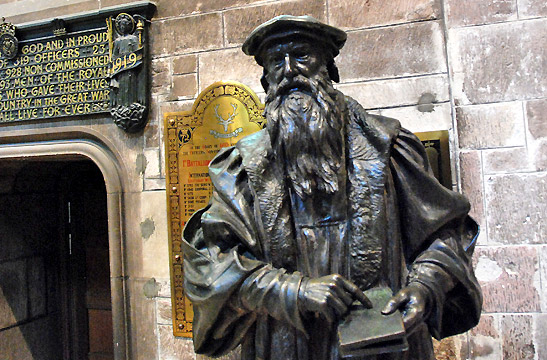
There's as much historical blood around the statue of Calvinistic John Knox in St. Giles Cathedral in Edinburgh, the capital of Scotland, and the chill that comes from viewing so stern and uncompromising a preacher. This was a man apparently who thought you should not smile on the Sabbath. A rigid Protestant he fought Mary Queen of Scots, his monarch, for years and for many reasons one of which that she was Catholic. When she was imprisoned for her beliefs more than 500 years ago Knox openly called for her execution.

John Knox statue in Edinburgh, Scotland

Knox, the son of a farmer, lived in an intolerant era. Religious reformers were often prosecuted for heresy. At one time Knox carried a sword as the bodyguard to the Protestant preacher George Wishart. Those were violent times. When the Catholic leader Cardinal Beaton burned Wishart at the stake in 1546 - he was, for revenge, murdered himself three months later. Knox was a prisoner in French Catholic galley ships for 19 months then later had to travel widely in Europe to avoid arrest. He finally returned to Scotland to thunder his long sermons at St. Giles and when he died in1572 the Regent of Scotland declared: "Here lies one who never feared any flesh."

Salvatore Dali, to be sure, led a different life from John Knox. Dali could laugh at himself and loved to play tricks on those who viewed his paintings. He would often transpose the numbers on any dated painting or bury other images within a more obvious work.

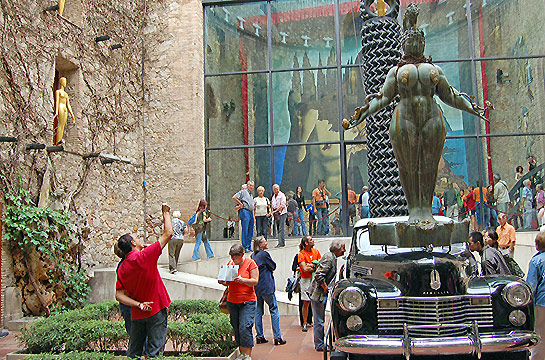
Salvadore Dali's Cadillac with bronze statue in front of the Dali Theatre-Museum, Figueres, Spain

Dali's Theatre-Museum in Spain's Costa Brava in the city of Figueres is a restored 19th century theater that burned down in the Civil War. It contains most of Dali's work and personality. The exhibits defy description: golden thrones, stuffed animals, elephant statues, weird sculptures, dissected bones, large eggs on rooftops and, inexplicably, dozens of large reproductions of the Academy Award statues. Those huge Oscars look down on Dali's 1978 "car-naval," his antique Cadillac and rising from it like a radiator cap a massive bronze "Queen Esther" by Dali's friend Ernest Fuchs. Dali called it his Rainy Taxi and, if you put a coin in the cab's meter, water falls from above showing why the highest point of the ensemble is an umbrella.

Dali said of Fuchs' bronze: "Her breasts are like wells. I thirst for the milk of knowledge." Although there are other Dali quotes on display in this museum such as "I believe a man has as much right to be insane as he has to be sane."

Tell Eric what you think of his article.
In the meantime, here are some of the feedback we have already received:


What a fascinating bit of Russian history you wrote about! How sad to learn that 100,000 churches were reduced to create skating rinks and such during the revolution, after seeing the photo of the interior of a magnificent church filled with art! War is so devastating on so many levels! The art of their culture is so beautiful as is shown in the image of the painted box! Thank you,

Yoka, Westlake Village, CA

Dear Yoka,

Thank you for writing. Nancy is originally Lutheran and Eric is a dour Scot, more used to the frequently cold and often cheerless churches of his native land so we were both overwhelmed to see the beauty of Russian churches. It was kind of you to write, Yoka.

Thank you,
Eric & Nancy

Interesting observations.... Very informative and thought provoking. Questions.... What would be the best way to get from Moscow Airport DME to boat dock? taxi? prearranged limo? prepaid Viking Tours transfer? Any idea on cost and travel time for taxi or limo or Viking Cruise pickup from airport to boat? We shall be flying to Moscow on our own. Do you happen to have an address for the river boat dock that Viking Cruises uses in Moscow? I would be nice to Google map the situation. Thanks,

Robert Hopwood, Ottawa, Canada

Hi Bob,

Excuse the delay; we were on a trip. I do understand your question and will try and get you an answer. The Viking river dock in Moscow was for us in the north part of the city but once we were on the boat it was an easy ten minute walk to the Metro station that had us downtown within 30 minutes. I'm a lot more relaxed at the end of a trip than at the beginning and therefore I always feel taking the cruise-line sponsored trip from the airport to the dock makes sense: What starts right usually ends right.

Eric & Nancy Anderson

Hi Bob,

I’m back with more information. The river port’s address is Northern River Boat Station Leningradsky Prospekt, Khimki. If you Google that you will see it is about 15 minutes’ walk from two Metro stations. http://www.aptouring.com.au/files/documents/17/29022_Moscow2.pdf .

I spoke to Nancy at customer relations at Viking Cruises at the new LNR Warner Center in 5700 Canoga Avenue, Woodland Hills, Calif.

She was very helpful and advises you to take the Viking transportation service. She is biased, of course, but she’s right. Moscow DME airport is 40 miles away on the opposite side of the city, at least two hours driving time. The airport has no Metro station; you’d have to take the Aeroexpress train to Paveletsky station then change to the Metro and go to Rechnoy Vokzal station then take a cab to the port. A cab all the way from DME would cost at least 2000 rubles (more than $70). That’s less than the $60 each that Viking would charge…but…I think you’d be ill-advised to do it on your own. Why start the trip where the potential to screw up is so likely? Moscow taxi drivers are as dishonest as most tourist city cab drivers and probably yours won’t speak English. I think the address in Russian is

BUT...

I strongly discourage you from economizing on this and doing it on your own. Buy the transfer and save money somewhere else.

We have other Viking Volga web articles up at http://travelingboy.com/archive-travel-eric-russia.html and at http://www.ericandersonsworld.com/story.php?id=6LvDg.

Good luck. Great show Canada’s putting on for the Olympics!

Eric & Nancy Anderson

Your blog keeps getting better and better! Your older articles are not as good as newer ones you have a lot more creativity and originality now keep it up!

Reseller Hosting, London

Hi, Is it Britni Freeman?

Thank you, we think... We suspect your comments are valid. In fact we think all of us writing for TravelingBoy are starting to get into the swing of things and do a better job -- and your encouragement spurs us to do even better. Thank you for writing. Have a good 2010,

Eric & Nancy Anderson

Dear Nancy and Eric

Thank you so much for the wonderful article on statues in Europe. Statues are my favorite art form and your descriptions were delightful to read - knowledge and fun together. I do still wonder about that foot in Rome...

Peggy - Pasadena, CA

Hi Peggy,

Thank you for writing. We appreciate your comments. We used to be critical of people who can't identify the persons on statues in foreign cities -- until one day a tourist stopped us in our own San Diego and asked us, in vain, for details on a statue we'd never noticed before! We wonder about that Roman foot too. If Eric had stood any closer he'd be in his typical foot-in-mouth position.

Eric & Nancy Anderson

I live in Santa Fe and see and delight in it every day, but your writing makes it sparkle even more. How nice to see Santa Fe through your eyes. Great photos!

Cynthia Whitney-Ward - Santa Fe, NM

Dear Dr. Anderson:

I have followed your writing career for as long as I can remember, and I think the thing I enjoy the most about your travel writing is the sense of joy and discovery that leads the reader to anticipate ever corner you turn in your travels.What a delightful traveling companion you are, and I know have always been, with that wonderfully eternally youthful joie de vivre...I wonder:do you feel that East, West, home is best? And where IS that place you have never been, but want to go most of all,yet? Bring we, your devoted readers ever along!

CAT -- San Diego (Scrips Ranch), CA

Dear CAT,

Thank for taking the time to write to TravelingBoy.com. You are very kind. We don't know that travel writers make the best companions; we suspect they may be obsessed with getting the best photograph or may monopolize the guide with questions so that others don't get to ask what interests them. What place is best? Well, it may be fun to sit in a rickshaw in Beijing or try to master the Metro in Moscow, but -- as you imply -- it is good to get home after trips.

Home is as comfortable as a pair of old shoes and home for many of us fortunately contains family.

We've never been to Easter Island and may have missed the boat (no pun intended) there. The island is losing its innocence; we've seen that happen at Machu Picchu or, closer to home, at Lake Powell in Arizona. So maybe the best travel advice is: Go when you are fit and healthy, before rising prices make a destination inaccessible -- and before hordes of tourists ruin any destination's mystique.

With best Holiday Wishes from Traveling Boy,

Eric & Nancy Anderson

* * * * *

What a fantastic primer on New York City. I think you have really captured its essence with this exciting overview of its offerings. Well done!

Gillian Abramson - New York

* * * * *

You describe a city on wheels - er, wings - and an absolutely perfect way to travel. SHOWERS & FLOWERS! Amazing! I love that your passion for all-things-aviation comes through in this story about an almost unbelievable airplane. Thanks for breaking the news in such an engaging way!

Richard Frisbie - Saugerties, New York

* * * * *

Enjoyed your blog on Romania. Noticed you called Bucharest "The Paris of the East." I wonder, is there any city not called "The Paris of something." I've read San Francisco is 'the Paris of the West,' Buenos Aires 'The Paris of South America,' and even Tromso, Norway 'The Paris of the Arctic.'

Terry Cowan - Fresno

* * * * *

Hi Terry,

Thanks for writing to TravelingBoy. And thanks for educating me; I didn't know that about Tromso, didn't even know there was a Tromso. I heard Bangkok called the Venice of the East when I was there and, in two weeks, I'm heading for the Venice of the North, St. Petersburg, Russia.

It does become a bit silly, doesn't it? But we are originally an immigrant nation that was Eurocentric. Maybe it gave our forefathers confidence even courage when they took old names, old ideas to the New World with them. I know I feel nostalgic if I drive around Ontario, Canada and see all the British place names.

I appreciate your email. Thank you for writing.

Eric

Eric -

Enjoyed your article on Madrid. I noticed that you find it superior to Rome. Most of the Spanish folks that I meet seem to prefer Barcelona. How would you rate that city?

Samuel K
Seattle

* * * * *

Hi Samuel,

We loved Barcelona although driving around the city was surprisingly complicated as our maps were inadequate. The cathedral had scaffolding around it so I couldn't get the pictures I wanted but we found the architecture fascinating and the Picasso museum rewarding. We were anxious to get on the road to Costa Brava and didn't have more than a couple of days in Barcelona.

Thanks for writing.
Eric


Great article on Madrid. I've heard there is a rivalry between the people of Madrid and Barcelona. In which city are the people friendlier? How about for hipness? I noticed you were Scottish. I felt a similar thing in Scotland, with a Glasgow v. Edinburgh vibe.

Gary
Santa Monica

* * * * *


Thank you for writing to TravelingBoy, Gary. We found Barcelona friendlier.

Maybe that's because it's not the capital and it's not so busy either. Maybe it's because the Gaudi architectural influence is pervasive and -- to both its citizens and tourists -- comforting. Maybe it's because Barcelona is the gateway to the work of artist Salvatore Dali, and his spirit catches us. (I don't know much about art but I've seen a lot of Dali's work enough to think he never took himself too seriously and often painted tongue in cheek. Maybe fun people spring for fun places?) Hipness? Madrid is more formal and dressy but Barcelona, I believe, is more hip maybe, again, because it's more fun.

Your points about Scotland are valid. It's more than a joke. The Glaswegians are more down to earth. I think we see it here in the belief that if you had a flat tire in Middle America passers-by would be more inclined to stop and help than perhaps New Englanders.

- Eric

Dear Eric,

I liked the article. As I read it, I was wondering how you as a physician were influenced by Hippocrates. What influence did this historical figure have on the practice of medicine beyond the obvious 'oath.' Why is Hippocrates considered to be such a paragon of medicine? DWA - San Pedro, CA

* * * * *


Dear David,

Thank you for writing to Travelingboy.com.

Hippocrates is revered because he believed his duty was to the individual patient, not to the community at large. This is a very important premise. The Romans, whose empire followed that of the Greeks, achieved much in health matters by emphasizing clean drinking water and personal hygiene, and created great national works like aquaducts and public baths but wealthy Romans apparently preferred Greek doctors as their personal physicians.

Hippocrates is also respected because he brought intellectual thought to diagnosis. He taught his students to use their five senses in assessing patients and was openly critical of the junk science of his day as practiced by the priest-physicians who preyed on the fear and ignorance of the ill persons who came to them.

It is true that not all medical chools today require graduating doctors to take the Hippocratic Oath but most conscientious physicians base their lifetime commitment to the practice of medicine on the life and teachings of that one man.

Or so I think. Perhaps if we knew more about our heroes they would seem less heroic. But in Hippocrates' case he did leave a record of his thoughts and some of his principles are today as strong as ever.

Thank you for writing, it is appreciated.

Eric


Name: Required
E-mail: Required
City: Required
Feedback:
 

Stay tuned.


© TravelingBoy.com. All Rights Reserved. 2008.
This site is designed and maintained by WYNK Marketing. Send all technical issues to: support@wynkmarketing.com

Travel Ad Long

Visit Norway ad

MySwitzerland.com

Sitka, Alaska ad

Montreal tourism site

Visit Berlin ad

official website of the Netherlands

Cruise Copenhagen ad

Sun Valley ad

Philippine Department of Tourism portal

Quebec City tourism ad

AlaskaFerry ad

Zurich official website

Zuiderzee Museum ad

Like-a-Local.com

American Jazz Museum ad