 |
 |
|

 |
 |
 |
 |
 |
 |
 |
 |
 |
 |
 |
 |
 |
 |
 |
 |
 |
 |
 |
 |
 |
 |
 |
 |
 |
 |
 |
 |
 |
 |
 |
 |
 |
 |
 |
 |
 |
 |
 |
 |
 |
 |
 |
 |
 |
 |
 |
 |
 |
 |
 |
 |
 |
 |
 |
 |
 |










 |
||
|
From Norway - Lutefisk
It is said that about half the Norwegians
who immigrated to America came in order to escape the hated lutefisk,
and the other half came to spread the gospel of lutefisk's wonderfulness.
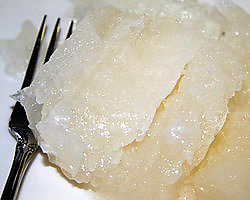
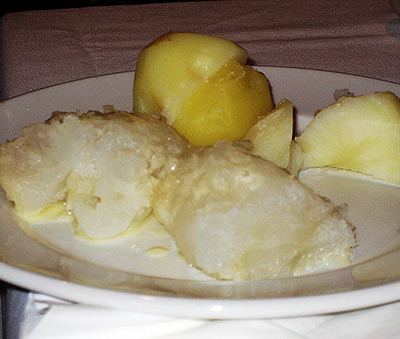
Everyone of Scandinavian heritage knows of Lutefisk (pronounced lou-tah-fisk), but for many it is more a source for jokes than actually eaten it. Lutefisk is a traditional Nordic food of dried cod or stockfish - today mostly made with dried ling - prepared in lye. It is soaked in cold water for five to six days (changed daily). In some recipes the fish is also hammered with a wooden mallet to soften it before its first soaking. It is then soaked again in another solution of cold water and lye for an additional two days. When this treatment is finished, a final treatment of yet another four to six days of soaking in cold water (also changed daily) is needed. Eventually, the lutefisk is ready to be baked in the oven for 40-50 minutes. Once cooked, the lutefisk has a very mild flavor and rather pronounced odor. People have mixed opinions of the deliciousness of the dish; some loving it, others feeling sick just from the smell of it. Never-the-less, Lutefisk is a popular Christmas dish in the U.S. that graces the holiday table for many people of Norwegian ancestry. It is generally served with baked potatoes and potato lefse - a flat and dense potato bread.
|

 he
he


Hi Audrey, Love your lamb shanks. --- Paul, Scottsdale AZ
Haven't been called Tad for . . .gee, maybe I've NEVER been called Tad . . . guess I'm the only one with chutzpah enough to mention Bourdain. BRILLIANT? --- Ken, Shutesbury, MA
I think we must have had an entirely different experience in the UK. (Fresh Food and Real Ale – week 1). We were up in Edinburgh and they served something called ‘Neeps & Tatties.’ The items were boiled so long that I couldn’t even recognize what I was eating. Come to think of it… I couldn’t taste them either. Later I found that Neeps’ are Turnips and ‘Tatties’ are potatoes. --- Lindy, Phoenix, AZ
My mouth was watering as I read some of your descriptions of the fantastic fare of ... England? I had always felt smug about the lowly reputation of British cuisine as this gave us at least one country with a worse culinary reputation than America's. I guess I'll have to change my views. Your article made me actually want to take a CULINARY tour of Britain. Yummy yummy yummy. --- Sandy Miner, Portland, OR Thanks for your note. Thanks to Traveling Boy I get to interview a world famous chef this week who is widely recognized as spearheading the Yummy movement in Ireland. Guess I'll have to take yet another culinary tour a little further north and check it out... (I love my job!) --- Audrey
Very interesting, mouth-watering piece by Audrey! (A McDreamy McMeel). Your web site is fascinating! --- Susie, Victoria, BC
Combining travel, food, and intelligent advice -- BRILLIANT! Your site fills a long-felt need for hungry roamers. Keep it up! It's Anthony Bourdain with reservations and CLASS. --- Tad, Boston, MA
|

|
| ||||
|
| ||||









This site is designed and maintained by WYNK Marketing. Send all technical issues to: support@wynkmarketing.com

|